
Get Help Now
If you use a VPN to protect your privacy online, you may have already noticed a frustrating pattern: some banks and credit unions will not let you log in while you are connected through a VPN.
Sometimes the warning is obvious. Other times it is not. You may get a vague connection error, a failed login, or a banking feature that suddenly stops working until the VPN is turned off.
I covered the broader issue in my earlier VPN article, but this post focuses specifically on online banking: why some financial institutions flag VPN traffic, which institutions are known or reported to restrict it, and what practical workarounds you can try.
BLUF: Banks do not always “ban VPNs” outright, but many fraud-detection systems treat VPN traffic as higher risk. That can lead to blocked logins, extra verification, or missing features even when you are a legitimate customer.
Why Banks Block VPN Access
Banks and credit unions prioritize fraud prevention, and VPN traffic can trip their risk controls. Shared VPN IP addresses, anonymous relays, data-center networks, and sudden location changes can all make a login look suspicious even when nothing malicious is happening. Ally states that it may block access when a connection is associated with suspicious activity, including certain VPN providers, internet relays, or public networks. Ally also says directly in its login FAQ that it does not allow VPN logins. https://www.ally.com/security/our-approach/
In practice, this can show up as:
- Login failures or vague connection errors
- Extra verification prompts
- Certain features refusing to work while the VPN is enabled
- Access returning as soon as the VPN is turned off
Confirmed vs. Reported VPN Restrictions
There is an important distinction here. Some institutions publish language that clearly confirms VPN-related blocking. Others do not publish it, but users repeatedly report the same behavior. That is why the list below separates confirmed cases from user-reported ones.
Confirmed
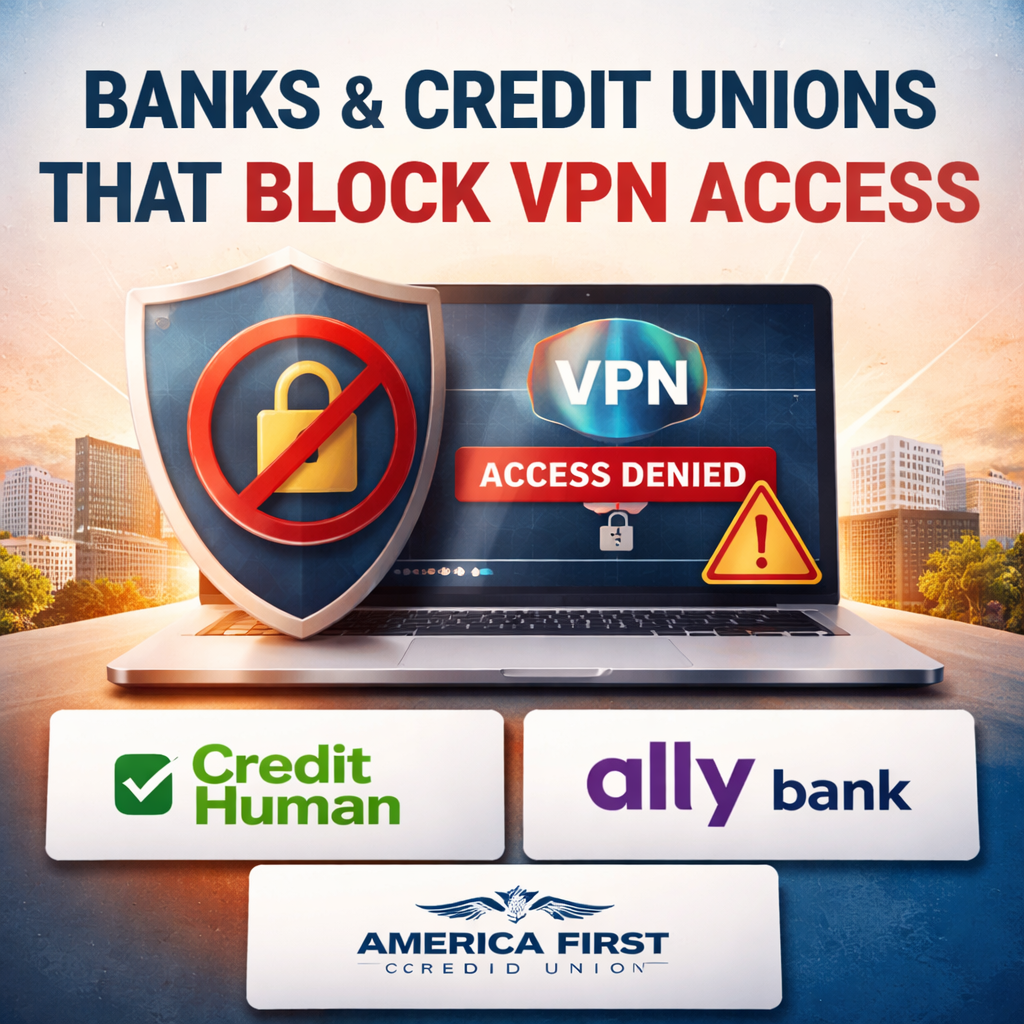
- Ally Bank – Ally’s help center says, “As a security measure, we don’t allow VPN logins,” and its security page also says access may be blocked for certain VPN providers and similar connections. https://www.ally.com/help/account-login-support/
User-Reported
- Credit Human – included here based on firsthand user experience and report patterns described in this article.
- America First Credit Union – user reports have described VPN-related access issues, but I did not find a current official policy page confirming it. https://www.reddit.com/r/VPN/comments/63p84p/companies_banks_blocking_vpn_providers/
- Bank of America – user reports exist, but I did not find an official consumer banking page confirming VPN blocking. https://www.reddit.com/r/VPN/comments/63p84p/companies_banks_blocking_vpn_providers/
Third-Party Cookies: Another Hidden Roadblock
It is not always just the VPN. Browser privacy settings can also interfere with online banking. Some banks and payment flows rely on cross-site cookies or embedded security flows that break when strict tracking protections are enabled.
The frustrating part is that fixing the login issue can mean loosening privacy settings you would normally want to keep locked down. That leaves privacy-minded users stuck between access and tracking.
How to Tell if Your Bank Is Blocking VPN Access
You may be dealing with VPN-related blocking if:
- The login works only when the VPN is off
- The site or app shows a connection, TLS, or security error
- A feature like deposit, transfer, or bill pay fails only while connected to the VPN
- Switching to a normal residential connection fixes the problem immediately
Workarounds That Actually Help
- Use split tunneling so only the bank traffic goes outside the VPN while the rest of your traffic stays protected.
- Try a dedicated IP if your VPN provider offers one. Shared VPN exit nodes get flagged more often.
- Use a nearby residential-looking endpoint instead of a distant or obviously data-center-based server.
- Temporarily disable the VPN for the login if you need a quick fix.
- Contact the bank and ask whether they block VPN or anonymized traffic. Some support teams will confirm it more clearly than the website does.
Privacy, Security, and Convenience Do Not Always Align
VPNs are useful privacy tools, but banks are optimizing for fraud prevention first. That creates a predictable conflict: what helps you look private can also make you look suspicious to a financial institution’s risk engine.
That does not mean VPNs are bad. It means banking sites often treat privacy tools as a higher-risk signal, especially when the connection appears to come from a shared or anonymized network. Ally’s published guidance is one of the clearest public examples of that approach. https://www.ally.com/help/account-login-support/
Final Thoughts
If your bank will not let you log in over a VPN, you are not imagining it. In at least some cases, the block is intentional. In others, it is the side effect of aggressive fraud detection.
The best path is usually to keep the article honest: separate confirmed policies from reported behavior, explain the security logic behind it, and give readers practical workarounds instead of just a complaint list.
Banks want certainty. VPNs reduce visibility. That is where the friction starts.
Join the conversation: Has your bank or credit union blocked you while using a VPN? Leave a comment and share what happened, especially if you found a workaround that actually worked.