BLUF: As I’ve been preparing to archive and preserve the original Star Trek series, I couldn’t help noticing something remarkable. Many of the technologies that once seemed impossible have quietly become everyday tools. Whether life imitates art or art inspires life, the line between science fiction and reality has become increasingly difficult to see.
Science Fiction Has a Funny Way of Becoming Science Fact
When the original Star Trek aired in the 1960s, its technology seemed almost magical.
Crew members spoke into handheld communicators, carried electronic tablets, talked naturally to a ship’s computer, and instantly communicated across enormous distances.
At the time, most of those ideas were firmly rooted in science fiction.
Today, many of them sit on my desk.
Technology That Quietly Became Reality
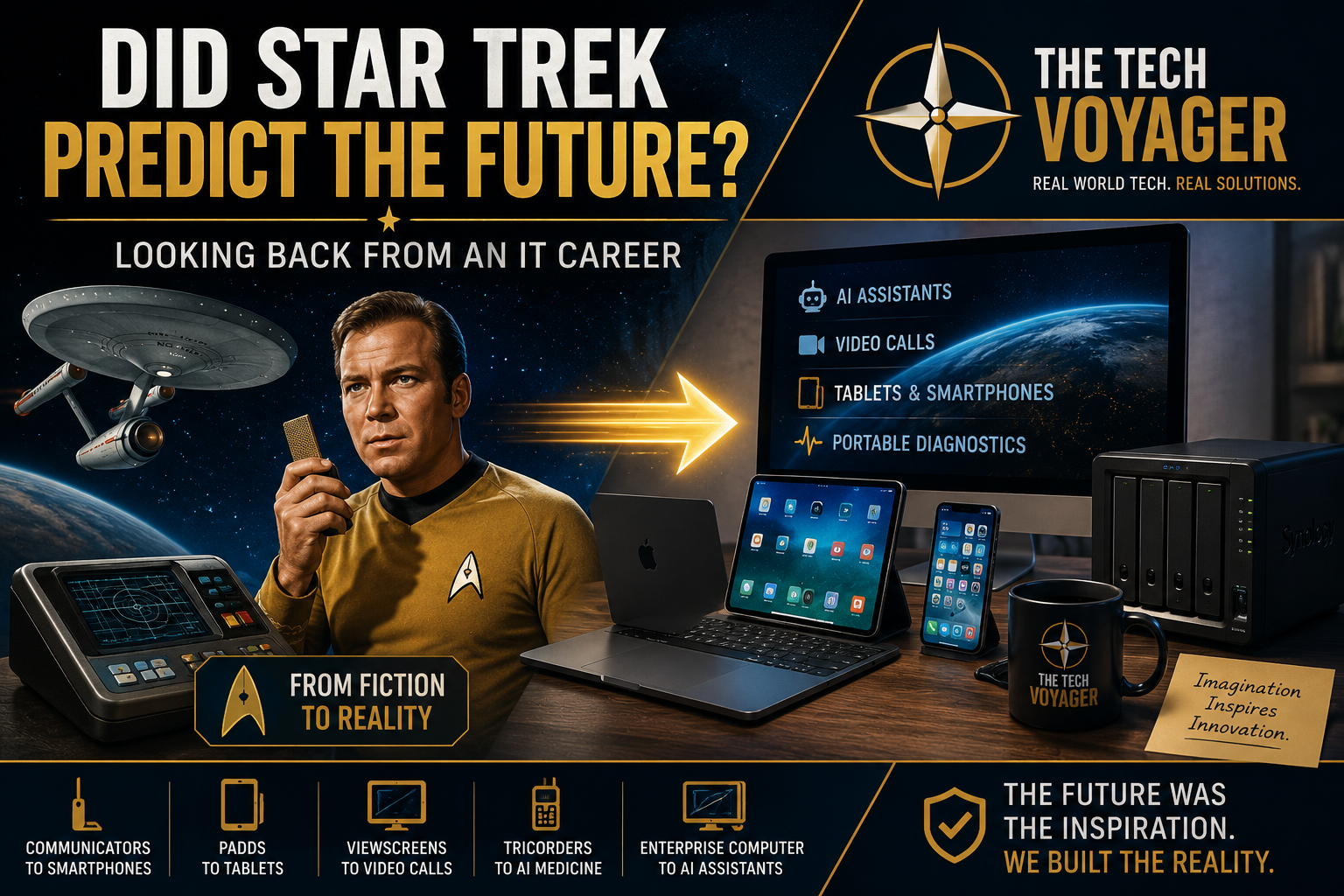
- Communicators became smartphones.
- PADDs became tablets like the iPad.
- The Enterprise computer evolved into conversational AI and large language models.
- Viewscreens became FaceTime, Zoom, and Microsoft Teams.
- The Universal Translator is now surprisingly close through AI-powered translation.
- Medical tricorders are beginning to appear through portable diagnostic devices and AI-assisted healthcare.
None of these technologies appeared overnight, but looking back, the similarities are difficult to ignore.
What Still Belongs in Science Fiction
Not everything from Star Trek has arrived.
- Warp drive
- Transporters
- Artificial gravity
- Replicators
Even so, modern technology continues to move in fascinating directions. We can 3D print objects, autonomous robots explore other planets, and artificial intelligence can generate text, images, music, voices, and software in seconds.
What once felt impossible now feels like the next logical step.
Watching Technology Grow Up
I’ve worked in IT long enough to remember when computers booted from floppy disks.
I remember when a 20 MB hard drive was considered impressive.
Dial-up internet wasn’t a joke—it was simply how everyone connected.
Cell phones made phone calls and very little else.
Today I routinely talk with artificial intelligence, maintain a multi-terabyte Synology NAS, stream media throughout my home, and carry more computing power in my pocket than entire businesses once owned.
If someone had described that to me thirty years ago, I probably would have assumed they had been watching too much Star Trek.
Did Star Trek Predict the Future?
I don’t think Star Trek predicted the future in the sense that it knew exactly what would happen.
I think it inspired people to build it.
Engineers, programmers, scientists, physicians, astronauts, and countless technology enthusiasts grew up watching those ideas on television.
Many eventually spent their careers trying to make pieces of that future real.
Sometimes imagination becomes the first prototype.
Lessons Learned
- Science fiction often inspires real innovation.
- Technology evolves gradually until it suddenly feels normal.
- Looking backward is sometimes the best way to appreciate technological progress.
- The tools we use every day were once considered impossible.
- Today’s science fiction may become tomorrow’s reality.
Final Thoughts
As I work through preserving my original Star Trek collection for Plex and future generations, I can’t help but appreciate the irony.
I’m using artificial intelligence, modern Apple hardware, a Synology NAS, and high-speed networking to preserve a television series that inspired generations of people to build the very technologies I’m using today.
Whether life imitates art or art inspires life may never be fully settled.
But after spending decades in information technology, I know this much:
We’re living in a future that once existed only on television.
“Imagination is the beginning of creation. You imagine what you desire, you will what you imagine and at last you create what you will.”— George Bernard Shaw