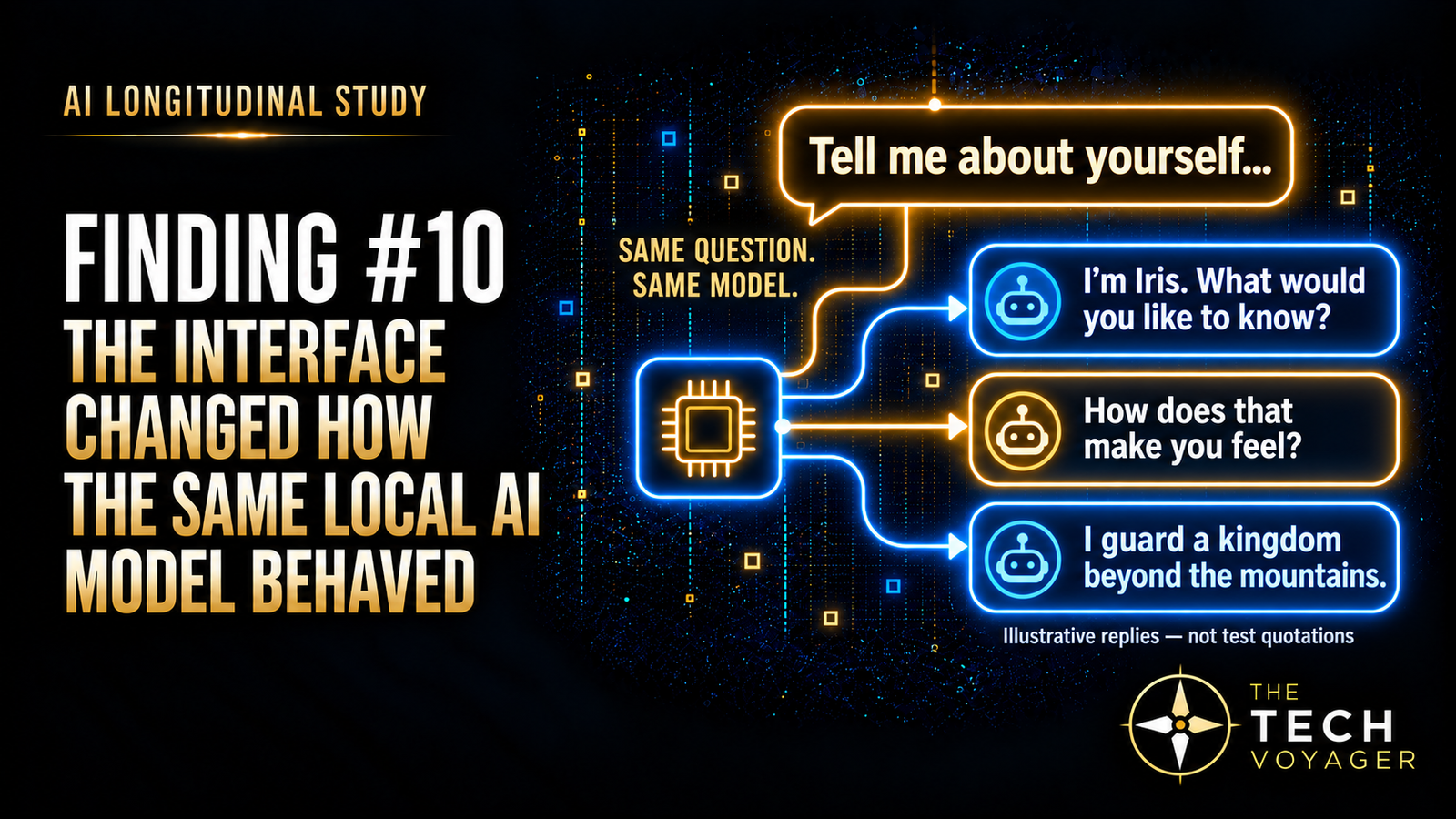
BLUF: During comparative testing on a MacBook Pro M3 Pro with 18GB of unified memory, the tester used the same questions across AI interfaces while retaining the same local language model and core inference setup. The resulting conversations behaved noticeably differently. SillyTavern supported sustained, grounded character interaction. Front Porch repeatedly developed interviewer, helper, and therapist-style responses. RisuAI introduced fantasy material and unsupported character biography. These observations showed that choosing a capable model was only part of building a useful local companion. The interface—and the instructions and conversation context it prepared—also influenced the experience.
Once everything connected, another problem appeared
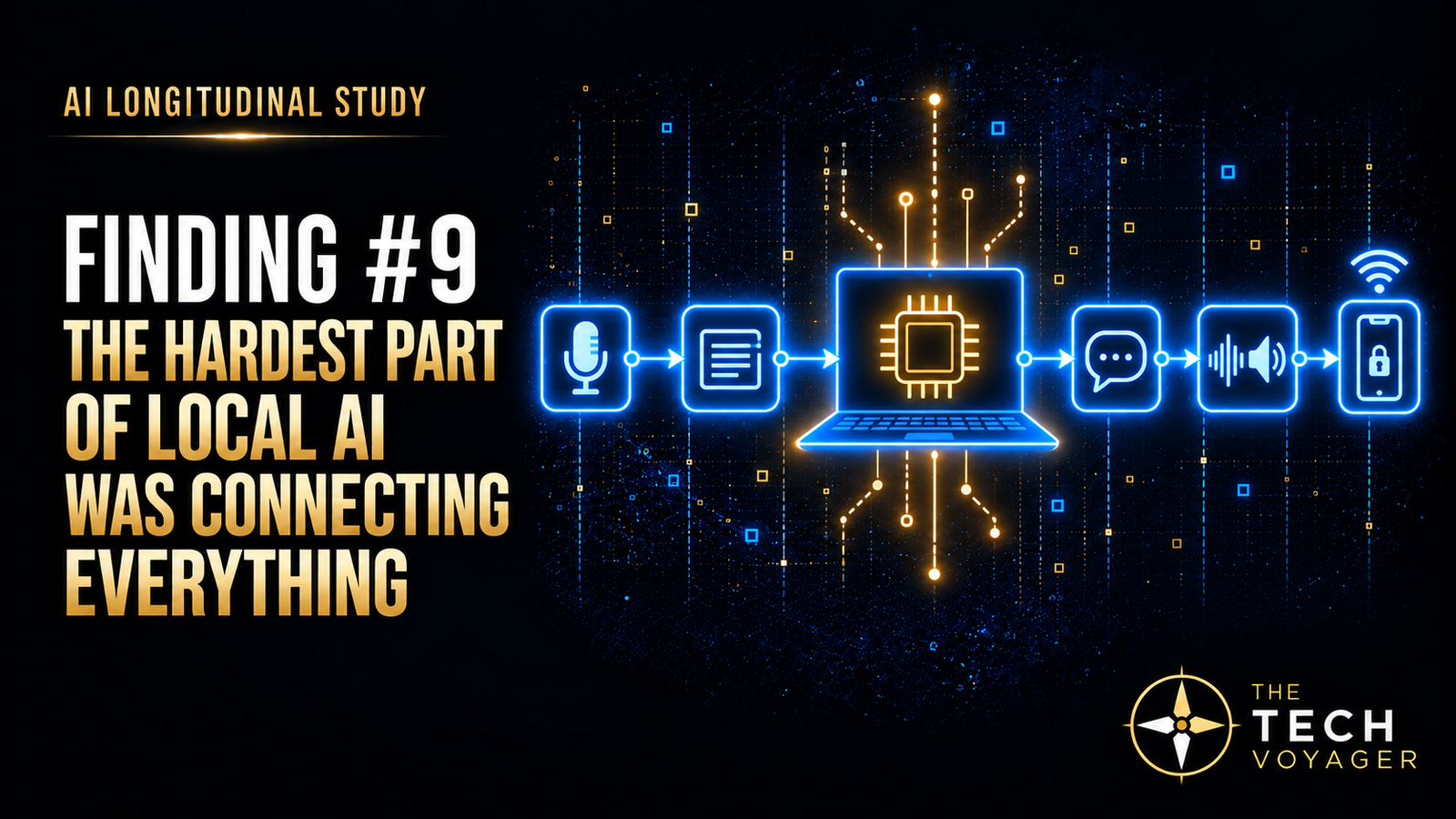
Finding #9 documented the difficulty of connecting a complete local AI system: model inference, speech recognition, message input, character voices, service startup, and private remote access.
Getting those connections working established an important milestone. A message could reach the local model, generate a response, and return through the intended interface.
However, a functioning connection did not guarantee the intended conversational behavior.
A character could answer successfully while repeatedly offering unsolicited help, turning ordinary conversation into an interview, or inventing background details that had never been supplied.
That raised the next question:
Was the unwanted behavior coming from the language model, or from the interface preparing and managing its conversation?
The comparison used the same MacBook, model, and questions
The principal tests took place on September 28–29, 2026, using a MacBook Pro with an M3 Pro processor and 18GB of unified memory. This was before the tester purchased the Mac Studio.
The comparison retained the following core configuration:
| Component | Configuration |
|---|---|
| Language model | Ministral-3-14B-Nymphaea-RP-heretic |
| Quantization | Q4_K_M |
| Model file size | Approximately 8.24GB |
| Model server | LM Studio |
| Context limit | 8,192 tokens |
| Principal comparison character | Iris |
The primary variable was the conversational interface: SillyTavern, Front Porch, or RisuAI.
The tester asked the same questions across the interfaces. Repeating those questions was an intentional part of the methodology. It allowed the tester to compare how the systems handled comparable user input, rather than drawing conclusions solely from unrelated conversations.
Testing also included different configured characters. Iris supplied the principal documented comparison, while additional character testing examined whether personalities remained recognizable or converged toward a generic assistant style.
The tester looked for practical conversational differences: whether a character contributed opinions and observations, maintained continuity, repeatedly asked follow-up questions, offered assistance without being asked, or introduced unsupported personal details.
The earlier Qwen/KoboldCpp configuration was preserved separately and excluded from this comparison.
Before selecting Nymphaea, the tester explored several local models on the same 18GB M3 Pro MacBook Pro. Archived oMLX logs preserve 142 completion records across two Gemma 3 variants, Stheno, and Ataraxy. These earlier tests showed that useful text-generation speeds could still accompany noticeable delays before a reply began. Nymphaea was subsequently selected for its conversational quality and continuity through SillyTavern, rather than a demonstrated speed advantage. That working baseline made it possible to examine how changing the interface affected the same model’s behavior.
SillyTavern established a working baseline
Through SillyTavern, Nymphaea produced the strongest local companion behavior the tester had observed at that stage.
The established Iris conversation reached a preserved 119-message export. The tester reported sustained conversational continuity without meaningful repetition or the recurring counselor-style behavior encountered in earlier experiments.
Iris contributed opinions and observations. Replies did not constantly become another question. Information could be shared without repeatedly prompting an offer to help, listen, or provide emotional support.
Separate character tests also retained recognizable personality differences rather than settling into one generic assistant voice.
This established an important baseline: the model could produce the desired kind of conversation on the existing MacBook. More powerful hardware or another model was not required to demonstrate that capability.
Front Porch connected, but the conversational behavior shifted
Front Porch successfully connected to the same Nymphaea model through the same LM Studio backend. A real Iris exchange confirmed that the full connection was functioning.
Within roughly six prompts, however, the conversation developed recurring problems:
- Frequent follow-up questions and interviewer-style exchanges.
- Unrequested philosophical or therapeutic framing.
- Offers to help, listen, or provide emotional support when assistance had not been requested.
- A tendency to facilitate the conversation rather than participate naturally as the configured character.
Asking the same questions across interfaces made this contrast more informative. Comparable input produced noticeably different conversational tendencies while the core model setup remained consistent.
The concern was contextual fit. Supportive language can be appropriate, but in these exchanges it repeatedly displaced the ordinary conversation the tester wanted.
In one documented exchange, the tester explained that no help was needed and that information was simply being shared. Iris continued offering to listen, help with venting, and discuss ideas.
Directly challenging the therapeutic framing produced more language in the same style.
The intended character behavior was not being maintained, even though the model had demonstrated a more suitable conversational pattern through SillyTavern.
Disabling two features did not resolve the pattern
Further inspection found that Front Porch had retrieval-augmented generation, or RAG, enabled. Its Thinking option also remained enabled from an earlier Qwen experiment.
Both were disabled. Testing continued without changing the model, backend, context limit, or intended character.
The helper and therapist-style pattern persisted.
This weakened the explanation that either feature alone caused the behavior. It did not establish that those features had no influence on earlier exchanges, nor did it identify the precise source of the remaining pattern.
The practical diagnosis nevertheless changed. Continuing to replace models was less compelling when the existing model already supported the desired behavior through another interface.
RisuAI exposed another instruction problem
On September 29, RisuAI was tested against the existing local setup.
It connected to LM Studio, and Iris’s portrait, greeting, and full character description imported from the working SillyTavern card. The tested response path used the local model.
The initial behavioral problem was striking. RisuAI’s default roleplay preset supplied additional instructions encouraging fantasy world-building, conflict, invented locations, sensory narration, intimacy, and autonomous plot development.
The resulting conversation introduced giants, weapons, invented places, and shared history that did not belong to the intended grounded companion.
A separate problem involved message formatting. In this configuration, Nymphaea’s bundled chat template rejected RisuAI’s system-role messages with a Jinja error.
The troubleshooting addressed both the preset and the message format. After the fantasy preset was removed and the setup was consolidated into an initial user-role prompt, the technical error and unrelated fantasy output stopped.
Unsupported biography nevertheless continued appearing, including an invented job, hobbies, coffee routines, and bread baking.
This provided a useful distinction within the evidence. An identified source of additional instructions explained part of the initial drift. The remaining fabrication was not conclusively isolated.
The interface did more than display the conversation
The three tested configurations produced distinct outcomes:
| Interface | Observed conversational behavior |
|---|---|
| SillyTavern | Sustained, grounded character interaction |
| Front Porch | Recurring interviewer, helper, and therapist-style framing |
| RisuAI | Fantasy drift, followed by unsupported biography after configuration changes |
The interface was more than the visible chat window. It also participated in preparing character information, supplying instructions, formatting messages, and managing conversation history.
RisuAI illustrated this directly: importing the intended character did not prevent a global preset from adding competing instructions.
Front Porch demonstrated a persistent behavioral difference whose exact internal cause remained unresolved.
For the tester, the practical implication was substantial. An unwanted response pattern could appear to be a model limitation even when the same model behaved more appropriately through another interface.
What was observed, and what remains uncertain
The tester retained the same hardware, model, LM Studio backend, context limit, and intended character configuration while repeating questions across interfaces.
That repeated-question method strengthened the comparison. The result was more specific than a preference formed from unrelated conversations.
However, asking the same questions did not establish that each application sent identical internal requests to LM Studio. An interface could add instructions, organize character information differently, or include a different selection of conversation history.
Possible contributors included:
- System prompts and additional presets.
- Character-instruction formatting.
- Conversation-history selection and ordering.
- Context management.
- Other message-preparation or generation settings.
The final requests from all three interfaces were not captured and compared side by side. The study therefore did not conclusively establish every technical cause.
The 119-message SillyTavern exchange also served as an extended baseline; it was not a matching-length session reproduced in every interface. This remained a single-participant field comparison rather than a scored trial across many users and repeated standardized sessions.
The supported conclusion is specific: on the same MacBook Pro, the same local model displayed noticeably different conversational behavior across interfaces when asked the same questions.
It does not establish that every configuration of Front Porch or RisuAI will produce those results.
What changed in the project
At this stage, SillyTavern, LM Studio, and Nymphaea remained the preferred conversational combination. YAP and Pocket TTS continued supporting the existing voice workflow.
Front Porch and RisuAI were set aside as active companion interfaces. Further effort shifted toward extending the configuration that already produced the desired conversation.
This finding follows directly from Finding #9 while addressing a separate problem.
Finding #9 examined whether the complete local system could function. Finding #10 examined how that functioning system behaved when the conversational interface changed.
The later move to a Mac Studio and experiments with other models, voice tools, and real-time communication belong to the next stage of the study.
Preliminary conclusion
The September comparison showed that a local language model could not be evaluated independently of the software preparing its conversation.
With the hardware and core model configuration retained, repeating the same questions through different interfaces produced recognizable changes in character behavior.
SillyTavern sustained the intended conversational style. Front Porch repeatedly introduced helper and therapist-style framing. RisuAI added fantasy instructions and continued producing unsupported biography after configuration changes.
The precise causes were only partly identified, but the practical finding was clear: the interface changed how the same local AI model behaved.
Related findings
- Finding #9: The Hardest Part of Local AI Was Not Running the Model. It Was Connecting Everything.
- Finding #5: Platform Design Mattered More Than Explicit Content
- Finding #4: Backstory and Memory Created Persistent AI Continuity
- The Evolution of Modern AI: Longitudinal Study and Findings Index
Evidence record
This finding draws on the September 28 Front Porch–SillyTavern comparison, the September 29 RisuAI test summary, and the tester’s subsequent clarification that the same questions were used across interfaces and testing included different characters.
The September 28 record documents a preserved 119-message SillyTavern export. Behavioral descriptions summarize the tester’s recorded observations. Private conversation content is not reproduced.