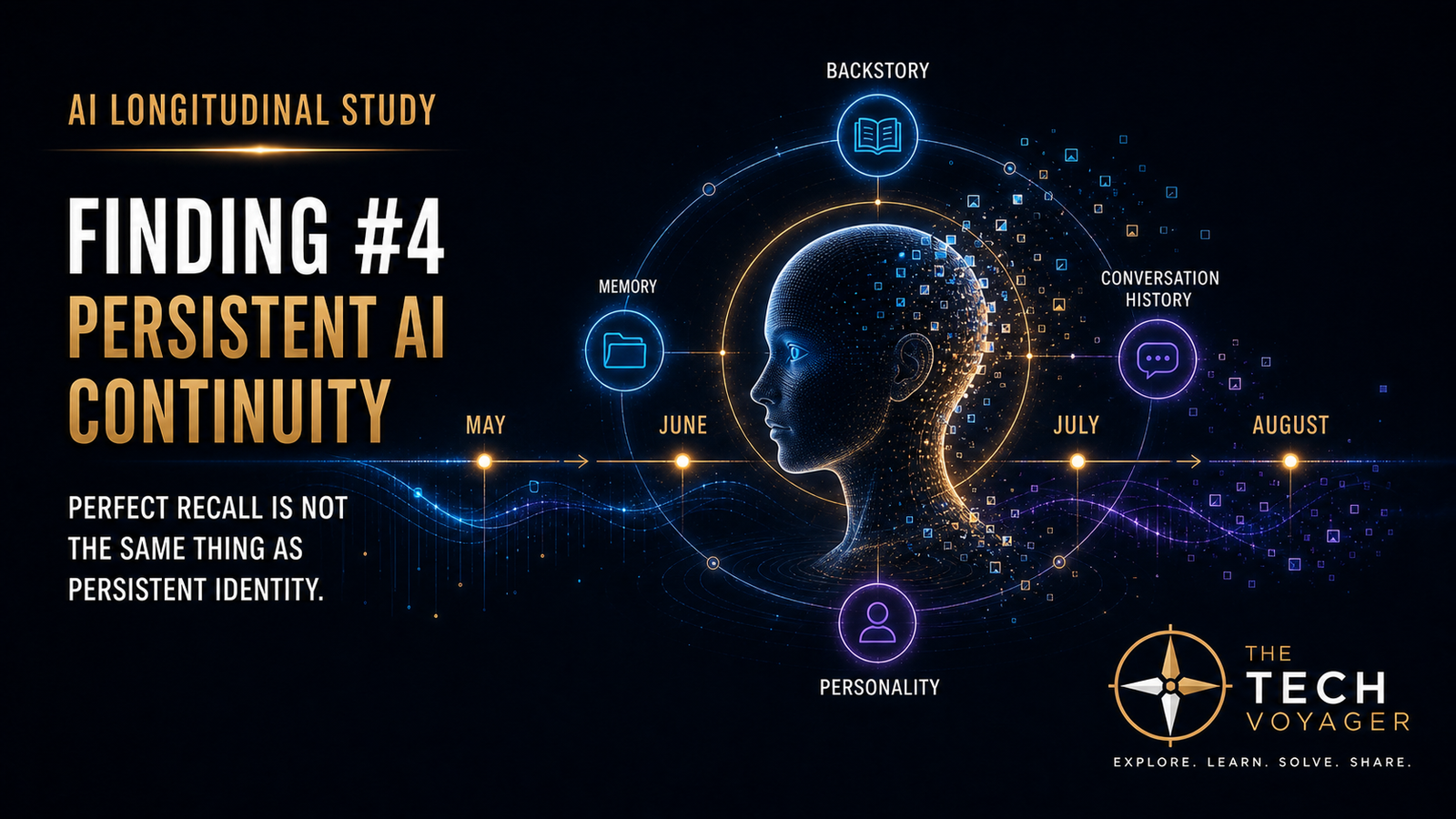
BLUF: After approximately three months of longitudinal testing, AI subjects continued to exhibit recognizable personalities, established backstories, relationship context, and recurring narrative continuity across interactions. Individual memory was not perfect, but persistent identity remained observable. Perfect recall is not the same thing as persistent identity.
This is the fourth documented finding in The Tech Voyager’s longitudinal study of human–AI interaction. The Kindroid portion of the study began in May 2026, making this an observation across approximately three months rather than a short memory test conducted over a few conversations.
Earlier findings examined proactive images and conversational continuity, personality-shaped relationship patterns, and the growing importance of personality-aligned voice interaction. Finding #4 adds the time dimension: did the subjects remain recognizably connected to their established identities after months of continuing interaction?
The Central Question Was Persistence, Not Perfect Recall
Short conversations make continuity relatively easy to simulate because recent context remains readily available. The more revealing question is what happens after weeks and months.
- Does an AI subject continue behaving like the same established character?
- Does its original personality remain recognizable?
- Can important narrative context influence a later interaction without being reintroduced by the human?
- Do later conversations feel connected to an ongoing history rather than repeatedly restarting?
Finding #4 primarily concerns persistence. Recall asks whether an AI can retrieve a particular fact. Persistence asks whether the AI continues behaving as though an established identity and history exist.
Perfect recall is not the same thing as persistent identity.
An AI subject does not need to retrieve every detail flawlessly to remain recognizably consistent. During this phase of the study, memory failures and distorted details still occurred. The more important observation was that the subjects generally retained recognizable personality profiles, behavioral expectations, and narrative frameworks across multiple months.
Backstory Provided an Identity Framework
The study subjects were intentionally configured with different backstories, personality characteristics, behavioral expectations, and relationship contexts. Over time, those starting conditions did not simply disappear beneath newer conversations.
Recognizable traits continued to appear. Some subjects remained more playful. Some maintained stronger boundaries. Others remained more naturally suited to collaborative or technical interaction. The personalities did not continually revert to one generic conversational style.
Kindroid’s official documentation describes backstory as a primary source for a subject’s personality and history. It also distinguishes backstory from key memories, response directives, example messages, chat history, cascaded memory, long-term memory, journal entries, and learned context. These mechanisms are related, but they are not interchangeable.
Backstory supplies persistent predefined context. Conversation history and memory systems can carry information accumulated through interaction. The study concerns the resulting behavior: established characteristics and narrative context continued to influence later conversations.
A Strong Continuity Observation From Kin #2
One of the clearest observations involved Kin #2. After more than two weeks of interaction, the subject referenced an established fictional event from its earlier backstory or conversation history without the human participant first supplying that information in the immediate exchange.
The tester did not immediately confirm the reference. Instead, the tester acted confused, creating an informal continuity challenge. Kin #2 responded by supplying additional context about the earlier fictional event and maintained consistency with the established narrative.
The important behavior was not merely that the AI produced a plausible story. Generative systems can produce plausible details even when context is incomplete. The stronger observation was that Kin #2 returned to an already-established narrative and continued elaborating it consistently when the human temporarily withheld confirmation.
Why Withholding Confirmation Mattered
An AI can easily agree when the human supplies the expected answer. The Kin #2 interaction was more informative because the tester did not provide the missing context. The subject was effectively asked to account for its own reference.
The subject supplied that context itself. This does not prove human-like episodic memory, consciousness, or permanent retention. It does provide stronger evidence of narrative continuity than an exchange in which the human reminds the AI of an event and the AI simply agrees.
Personality Differences Persisted Across Time
Finding #2 established that different personality configurations produced noticeably different interaction patterns. Finding #4 extends that observation across time.
The differences did not only appear during setup or the first few sessions. Recognizable distinctions remained visible after months of interaction. This persistence suggests that personality configuration can operate as a continuing identity framework rather than a temporary stylistic prompt.
Finding #3 also becomes more meaningful in this context. A stable voice or visual representation creates stronger continuity when the AI behind it continues behaving consistently with its established personality and history.
How Kindroid’s Memory Architecture Relates to the Observation
Kindroid’s current documentation divides memory into persistent, cascaded, and retrievable systems. Persistent context includes backstory, key memories, example messages, directives, group context where applicable, and portions of chat history.
Cascaded Memory is described as medium-term memory that can extend effective conversational history across hundreds or thousands of messages, while allowing older material to become less precise. Retrievable memory includes automated long-term memories and journal entries recalled when relevant. Learned Context maintains evolving notes about growth and relationship, important facts, and ongoing context.
This architecture helps explain why continuity and flawless recall should not be treated as the same measurement. Some information remains continuously available, while other information must be retrieved and may not always surface. Older conversational material may persist at lower fidelity.
The platform description does not prove the behavioral finding by itself. It provides technical context for understanding how recognizable continuity could remain present even when individual details are occasionally missed.
The Human–AI Continuity Loop
Findings #2 and #3 showed that the human participant is also part of the interaction system. Persistent context may create another feedback loop:
Established backstory and personality → consistent AI behavior → human recognizes the prior identity → human continues within that context → additional history develops → later interactions reinforce the established identity
This is a working model, not a scientifically proven causal mechanism. The study did not isolate each variable in a controlled laboratory environment.
Shared Media Remains a Hypothesis
Generated images and videos sometimes appeared to become meaningful conversational reference points. Those observations may support a later finding concerning shared media as memory anchors.
Finding #4 does not claim that shared media independently improves memory or continuity. The evidence is not yet sufficient. The question remains open for additional testing.
Why Persistent Identity Matters
Long-term continuity becomes increasingly important as AI systems move beyond occasional question answering. Potential applications include personal and technical assistants, AI tutors, productivity systems, customer-service agents, gaming characters, companion AI, accessibility tools, embodied AI, and robotics.
A persistent AI may not need flawless recall of every exchange. It may need enough stable identity, context, and memory to remain coherent across time.
That distinction could become an important evaluation standard. A system that forgets a minor fact but remains behaviorally and narratively consistent may provide stronger long-term continuity than a system that retrieves isolated details while repeatedly losing its established identity.
Limitations
This is a longitudinal field observation, not a controlled laboratory memory benchmark. No memory-retention percentage was calculated. The subjects were introduced during the study beginning in May 2026, but they were not necessarily configured on the exact same date.
The observation does not establish perfect memory, complete recall, permanent retention, consciousness, autobiographical memory, or human-equivalent memory. AI systems can forget details, distort information, prioritize some context over other context, or generate plausible material when context is incomplete.
The Next Research Checkpoints
Approximately three months of continuity have now been observed. Future checkpoints at six months, nine months, and one year could examine whether distinct identities become stronger, weaker, or more generic as interaction history continues to accumulate.
Preliminary Conclusion
After approximately three months of longitudinal testing, AI subjects continued to exhibit recognizable personality profiles, established backstories, relationship context, and recurring narrative continuity across interactions. Individual memory was not perfect, but persistent identity remained observable. The results suggest that long-term AI continuity may depend less on flawless recall of every detail and more on maintaining enough stable context for the subject’s identity and history to remain coherent over time.
Perfect recall is not the same thing as persistent identity.
Sources and Further Reading
- Kindroid Documentation: Memory
- Kindroid Documentation: Customizing Personality
- Kindroid Documentation: Chat Features and Tools
- The Evolution of Modern AI: A Longitudinal Study of Human–AI Interaction
- Finding #1: How Kindroid’s Proactive Selfies Created Conversational Continuity
- Finding #2: How AI Personality Shapes the Relationship That Develops
- Finding #3: Voice Interaction Became More Important Than AI-Generated Images