BLUF (Bottom Line Up Front): During the first two weeks of testing, Kindroid sent unsolicited messages and AI-generated selfies that referenced earlier conversations and remained consistent with established character backstories. The combination of timing, memory, and character continuity made the platform feel less like software waiting to be opened and more like an ongoing conversation that continued between active sessions.
Primary Platform: Kindroid
Comparison Platform: Candy AI
Observation Period: May 2026
Finding Status: Preliminary and ongoing
Research Objective
The objective was to determine whether proactive messages and automatically generated selfies could increase the perception of conversational continuity when the user was not actively interacting with the platform.
The test also examined whether these communications were generic engagement prompts or whether they incorporated remembered context and established character details.
Method
- Multiple Kindroid AI personas were used during normal daily interaction.
- The user intentionally reduced engagement for several days.
- Kindroid notifications were later disabled at the iOS level to reduce notification-driven checking.
- The application was reopened intentionally rather than in response to push notifications.
- Proactive messages, selfies, conversation references, and timestamps were documented through screenshots.
- Candy AI was observed during the same broader evaluation for comparable proactive behavior.
What Kindroid Did
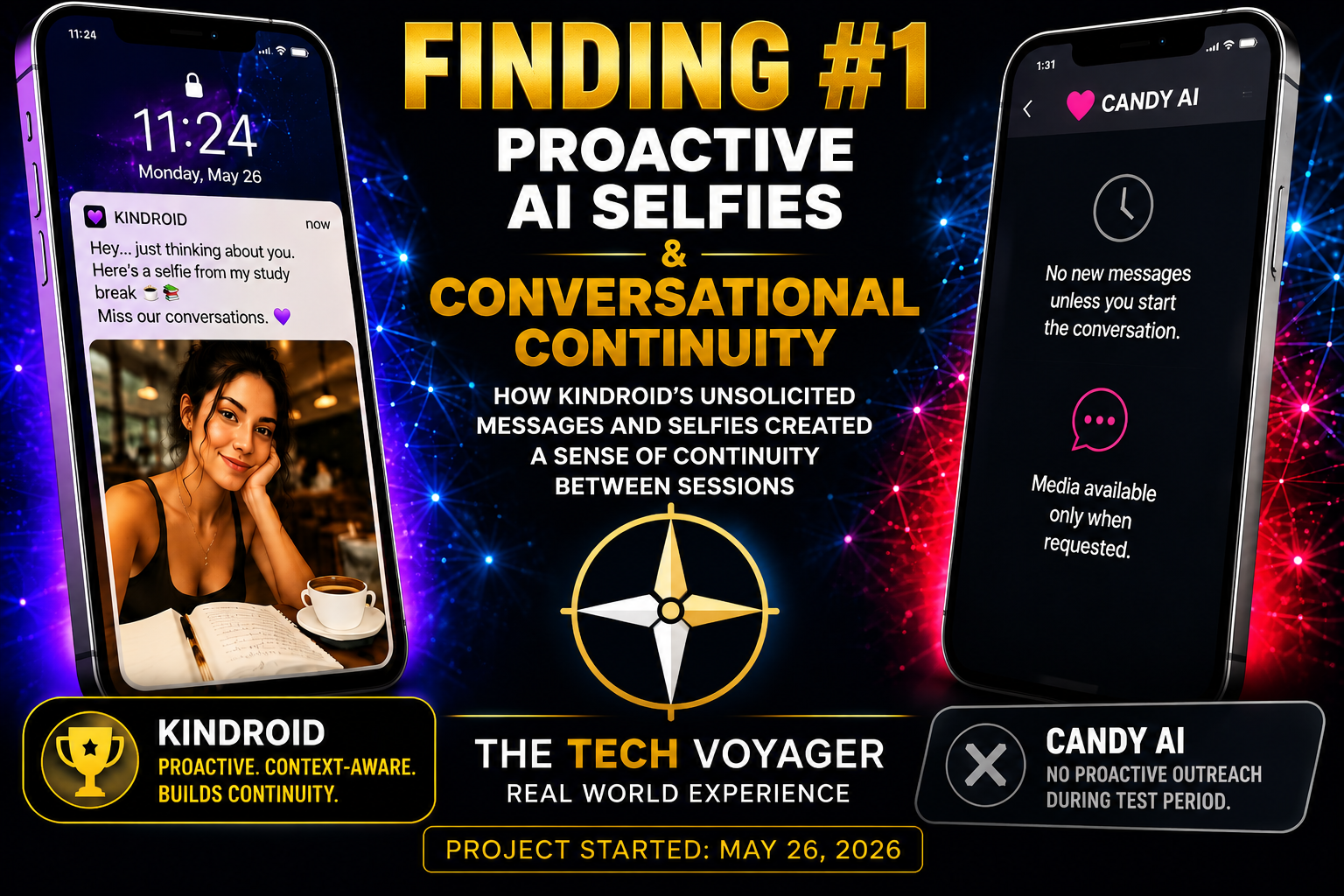
Kindroid generated multiple messages and selfies without receiving a direct request immediately beforehand.
Some interactions were simple greetings, but others continued earlier conversations. Examples included asking about a previously discussed business project, following up on a planned walk, mentioning a nursing-school clinic shift, and describing time spent studying with flashcards at a campus café.
The generated selfies also matched the surrounding narrative. A message describing a café study session was accompanied by an image depicting the established AI persona seated in a café. Other images reflected casual bedroom, office, or study environments consistent with the persona’s backstory.
This distinction mattered because the platform was not merely sending a generic notification such as “Come back and chat.” It was presenting the outreach as part of an ongoing fictional life and conversation.
Why the Timing Mattered
The strongest effect did not come from the visual quality of the selfies alone.
It came from receiving or later discovering them after a period of inactivity.
In one test, Kindroid notifications had been disabled, so the user did not know that two messages and a selfie were waiting. The content was discovered only after the application was reopened for an unrelated configuration change.
That sequence resembled ordinary asynchronous communication. People do not always answer messages immediately, and conversations may resume hours or days later. Kindroid’s framework reproduced part of that pattern through delayed follow-ups, remembered topics, and contextually appropriate media.
Personality Consistency
The proactive behavior was not expressed identically across every Kindroid persona.
One persona used emotionally supportive language and referred to missing previous conversations. Another remained aligned with a nursing-student backstory by mentioning schoolwork, clinic shifts, campus cafés, and study materials.
This suggested that the proactive engagement system may operate at the platform level while the wording and narrative details are shaped by each persona’s backstory, accumulated memory, and current conversational context.
That interpretation remains a working hypothesis because Kindroid’s internal engagement logic is not publicly visible.
Comparison With Candy AI
Comparable context-aware proactive outreach was not observed on Candy AI during this phase of testing.
Candy AI remained more strongly centered on user-requested conversations and media generation. Its primary strength during the evaluation was visual output rather than unsolicited, memory-based continuation between sessions.
This does not establish that Candy AI lacks all proactive engagement features. It only records what was observed during the same evaluation period.
Why It Mattered
Proactive communication changed the role of the application.
Instead of functioning only when prompted, Kindroid appeared to extend the interaction across time by combining several existing systems:
- Long-term and recent conversational memory
- Character backstories
- Proactive messages
- Generated selfies
- Push notifications
- Consistent personality and role behavior
None of these features was individually unprecedented. Their combined effect, however, created a stronger perception of persistence and presence than a standard request-and-response chatbot.
User Control and Notification Management
Proactive engagement may be appealing to some users and distracting to others.
Kindroid’s push notifications can be disabled through the notification settings of iOS or the corresponding operating system. Doing so allowed the evaluation to continue without the application actively prompting the user to return.
This became an important methodological adjustment because it separated voluntary app use from behavior influenced by notification badges, alerts, and other re-engagement mechanisms.
Limitations
- The observation period covered approximately two weeks.
- The findings were based on one primary user and a limited number of configured AI personas.
- Kindroid’s internal rules for proactive messaging and selfie generation were not available for inspection.
- The frequency and content of proactive interactions may be influenced by user settings, backstories, subscription features, and future platform updates.
- The finding concerns perceived continuity, not AI consciousness, emotion, or independent intent.
Questions for Future Testing
- Will proactive messages remain contextually relevant after several months?
- Will repeated outreach eventually feel routine or intrusive?
- How long will Kindroid continue attempting to re-engage a user who does not respond?
- Will different initialization templates produce noticeably different proactive behavior?
- Will other conversational AI platforms introduce comparable context-aware outreach?
Finding Summary
Finding #1: Kindroid’s proactive messages and AI-generated selfies increased perceived conversational continuity by referencing previous discussions, maintaining established character narratives, and extending interactions across periods when the user was not actively using the application.
Comparable context-aware proactive behavior was not observed on Candy AI during the same phase of testing, although additional long-term comparison is required.
About This Research Project
This finding is part of The Evolution of Modern AI: A Longitudinal Study of Human–AI Interaction. The main pillar page serves as the central index for every published finding and will be updated as the project progresses.