
Observation period: Approximately one year
Recorded during: Month five of the formal longitudinal study
BLUF: Over approximately one year of regular use, the participant’s experience with ChatGPT shifted from answering isolated questions to supporting continuing creative, organizational, and technical projects. The platform assisted with preserving a family cookbook, developing books, creating imagery, managing projects, planning recurring work, producing YouTube content, exploring design ideas, and completing increasingly complex Codex workflows. This is a neutral observation about one selected platform. It is not an endorsement, a product ranking, or a recommendation to purchase a subscription.
When ChatGPT first became widely available, much of its appeal came from a simple novelty: a person could type a question and receive a conversational answer.
That was also how the human participant initially approached it.
Early use centered on testing what the system knew, how it responded, and whether its answers were more useful than a conventional internet search. The participant moved to a paid Plus subscription within roughly 30 days after recognizing that the platform might offer value beyond occasional questions.
Approximately one year later, questions and answers represented only a small portion of the participant’s use.
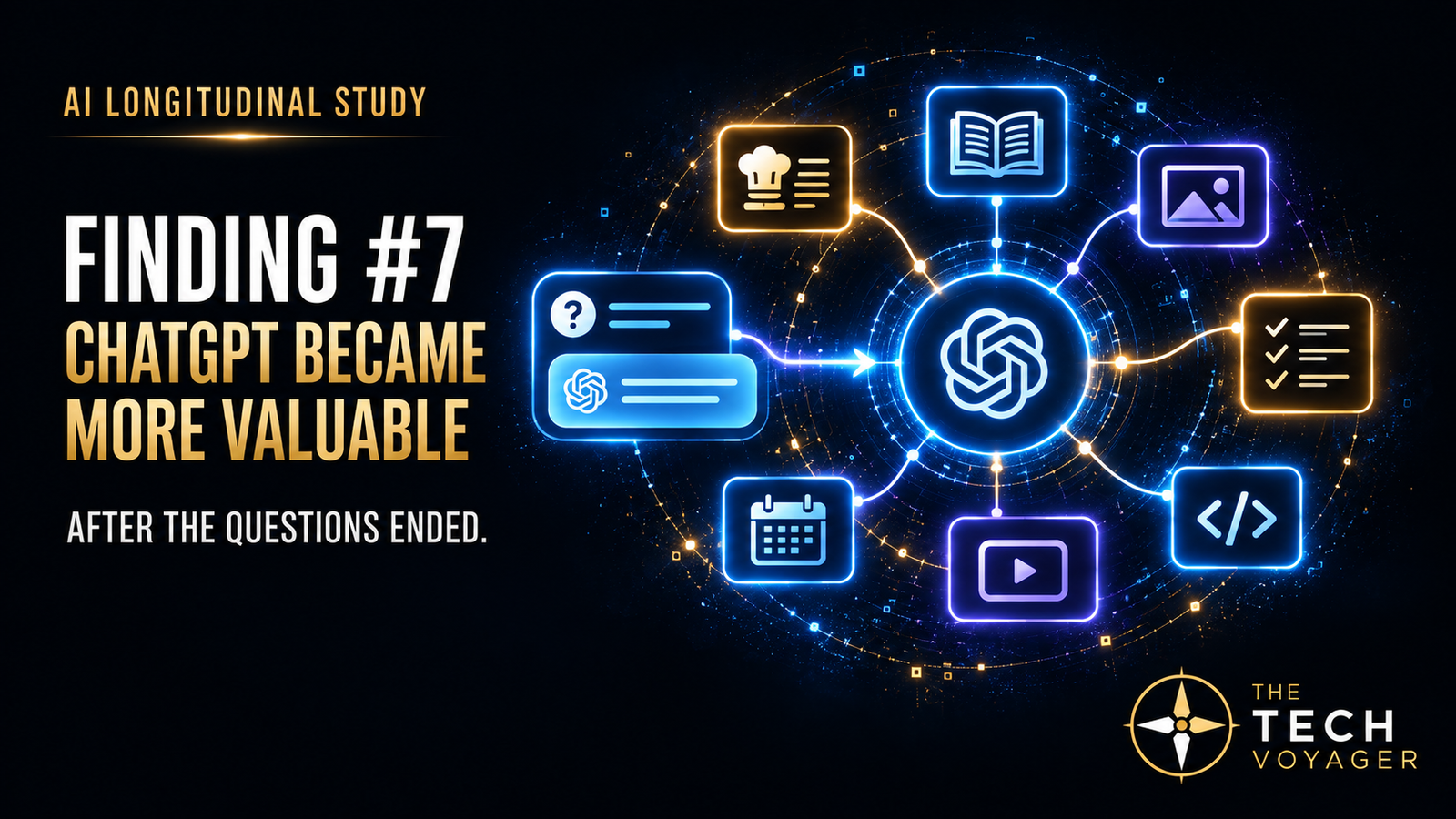
The more significant change was not simply that ChatGPT gained additional features. The participant gradually stopped treating it as a destination for isolated answers and began using it as a continuing collaborator across creative projects, personal archives, technical production, planning, and experimentation.
Why this finding singles out ChatGPT
ChatGPT is one of five platforms included in the broader longitudinal study. It is examined separately here because the participant had accumulated approximately one year of use across an unusually broad range of documented activities.
Its selection does not establish that it was the best available AI platform. It does not imply that competing systems could not perform similar work. Other platforms in the study served different roles, and Claude was also used for writing. Those experiences may support separate findings when enough distinct evidence has been assembled.
Finding #7 therefore records what happened with one platform under one participant’s pattern of use. It is not a comparative ranking, an advertisement, or a recommendation that another person should subscribe.
The initial question-and-answer phase was only the beginning
Question-and-answer interaction provided an accessible introduction to generative AI. It required little preparation, produced an immediate result, and allowed the participant to explore the system conversationally.
That form of interaction remained useful, but it did not become the primary reason for continued use.
When the participant needed a straightforward factual answer, conventional reference sources and internet searches often remained sufficient. ChatGPT became more distinctive within this observation when a subject required exploration: developing an idea, comparing possibilities, revising an approach, organizing scattered information, or continuing work across several connected steps.
The conversation was no longer the final product. It became the workspace in which a product, decision, or project could take shape.
Projects replaced isolated prompts
Over time, ChatGPT became involved in a broad range of continuing work.
One major example was the preservation of the participant’s mother’s cookbook. That project required more than transcribing recipes. It involved organizing scanned recipe cards, preserving uncertain wording, separating original materials from working copies, preparing consistent WordPress drafts, generating supporting metadata, and maintaining a human review process before publication.
The platform also supported book development and other long-form writing. Instead of generating a complete book from a short prompt, the useful work occurred through repeated discussion, organization, revision, and refinement.
Visual work became another recurring use. ChatGPT assisted with image concepts, featured graphics, character references, comic panels, branding, and the translation of an idea into a more precise visual specification. Images were often reviewed and corrected rather than accepted as one-step outputs.
The participant also used ChatGPT for practical planning, including reminders, scheduling, backyard design concepts, tree-trimming considerations, and general project organization. Some of these activities produced formal deliverables. Others were exploratory conversations that helped clarify what the participant wanted to do.
Across these different uses, the common element was continuity. The participant was not repeatedly asking unrelated questions. Work accumulated around recognizable projects with their own source material, preferences, constraints, and history.
YouTube production expanded the role further
THE Tech Voyager YouTube work demonstrated how far the interaction had moved beyond ordinary chat.
Producing a Short could involve reviewing source material, shaping narration, maintaining the intended panel order, synchronizing visuals with audio, protecting caption-safe areas, rendering a final video, checking technical properties, and preparing the title, description, pinned comment, and playlist information.
Similar workflows developed around Movie Shorts and other channel content.
These activities required several kinds of work to remain connected. Editorial decisions affected visual production. Narration determined timing. Timing affected the render. The finished video needed matching metadata. Published or scheduled episodes needed to be recorded so completed assets could be archived without disturbing unrelated projects.
ChatGPT’s value in these cases did not come from one exceptional answer. It came from helping carry an idea through multiple stages while preserving the participant’s established production rules.
Codex changed what using ChatGPT meant
The participant’s recent use of Codex extended this progression.
Conversation could now lead directly into work performed within a project: inspecting files, organizing evidence, creating or revising assets, checking outputs, operating repeatable workflows, and preparing finished deliverables for review.
The reconstruction of this longitudinal study provides one example. After earlier research conversations were accidentally deleted, the surviving website, project history, uploaded records, and preserved context were compared to distinguish confirmed findings from candidate ideas. That reconstruction did not recover every lost sentence or original number. It did recover enough of the research structure to preserve the published findings and identify where evidence remained insufficient.
Finding #6 then moved through an integrated workflow. The surviving evidence was reconciled, a privacy-conscious article was drafted, a featured image was generated and corrected to match THE Tech Voyager branding, and the article was transferred into WordPress for human review. After publication, the study index and category structure were updated.
This was not a conventional question-and-answer exchange. It was a continuing production process with research, editorial, visual, technical, and publishing stages.
Official OpenAI materials describe ChatGPT and Codex workflows involving continuing project context, evidence synthesis, documentation, visual prototyping, workflow analysis, and reviewable artifacts. Those descriptions provide product context. The finding itself comes from the participant’s observed use rather than from the manufacturer’s claims.
The value included substantial time savings
Paid AI services are often discussed in terms of productivity, business growth, or financial return. The participant did not maintain a controlled time log, so the exact number of hours saved cannot be calculated.
Even so, the accumulated savings across research, writing, image development, project organization, video production, troubleshooting, scheduling, and WordPress work were substantial—reasonably measured in many hours and likely days over the course of the year.
This remains a participant-reported estimate rather than a controlled productivity measurement. No calculation was made of labor replaced, revenue created, or financial return on the subscription.
The participant did not report earning money as a result of this year of use. The sustained value came from a different combination of outcomes: projects moved forward, personal material was preserved, creative ideas became tangible, unfamiliar work became more approachable, and the overall experience remained enjoyable.
That does not mean every interaction was successful. Answers sometimes required verification. Generated images needed correction. Context was occasionally lost. Deleted conversations complicated the research reconstruction. Some attempted workflows failed or required a different approach.
Continued use therefore did not result from perfect performance. It resulted from the platform remaining useful across enough different activities to justify returning to it.
Exploratory conversation became more important than simple answers
The participant reported using ChatGPT for direct questions relatively infrequently. Conversations were more often exploratory.
An exploratory conversation does not begin with the expectation that the first answer will be final. The participant may begin with an incomplete idea, react to suggestions, reject unsuitable directions, add context, and gradually discover the actual objective.
This style of interaction proved useful for creative work and practical planning because many real projects do not begin with a perfectly formed request. The ability to think through a subject conversationally became part of the value.
The useful outcome could be a finished artifact, but it could also be a clearer decision, a better-defined project, or the realization that an idea was not ready to pursue.
How Finding #7 connects to the earlier findings
Finding #1 showed how context-aware proactive media could continue an interaction between active sessions. Finding #7 extends the broader continuity theme beyond companion behavior: ChatGPT became more useful when individual conversations contributed to continuing projects instead of remaining isolated exchanges.
Finding #2 documented how different personality configurations produced different interaction patterns. Finding #7 examines a different dimension of sustained use—the working pattern that developed when the participant approached one platform as an exploratory collaborator rather than primarily as a question-answering tool.
Finding #3 found that the importance of individual capabilities changed over time. Finding #7 records a similar change at the platform level: initial interest in conversational answers gave way to greater value from writing, imagery, planning, production, and project execution.
Finding #4 distinguished persistent continuity from perfect recall. That distinction also applies to project collaboration. ChatGPT did not preserve every conversation or detail perfectly, but enough context, files, instructions, and completed work survived to support recognizable projects over time.
Finding #5 concluded that integrated capabilities became more important than any single attention-grabbing feature. Finding #7 provides a practical example: the participant’s value came from combining conversation, research, writing, imagery, organization, automation, and file-based work rather than relying on one standout capability.
Finding #6 examined AI-initiated continuity and the competition for human attention. Finding #7 approaches continued engagement from the other direction. The participant returned because active projects, accumulated context, and useful outcomes created reasons to continue—not because the study established that reminders or proactive outreach caused that return.
This finding is not a product endorsement
This observation comes from one human participant using ChatGPT across personal, creative, and technical projects for approximately one year. The article is not sponsored by OpenAI, contains no affiliate relationship, and does not recommend ChatGPT over another platform.
It does not establish that ChatGPT makes every user more productive. It does not prove that the participant could not have completed similar projects using Claude or another system. It also does not establish that a paid subscription provides a financial return.
The participant selected ChatGPT for this finding because it had the longest and broadest documented use within this part of the study. Claude’s use in writing projects remains relevant, but it should be assessed on its own evidence rather than inserted into this article as an incomplete comparison.
Some completed outputs and workflows were preserved and could be inspected. Other activities—including book development, reminders, backyard planning, and tree-trimming discussions—remain participant-reported uses because not every original conversation survived.
The platform also changed during the observation period. Earlier and later interactions did not necessarily use identical models, interfaces, tools, or capabilities.
Preliminary conclusion
During approximately one year of use, the participant’s experience with ChatGPT shifted from occasional questions toward continuing creative, organizational, and technical work.
The platform did not produce a documented financial return, but the participant reported substantial accumulated time savings—many hours and likely days over the course of the year. It also contributed to completed projects, preserved personal material, creative momentum, practical assistance, and an enjoyable continuing AI experience.
This result does not establish that ChatGPT is superior to another AI platform. It documents a narrower change in one participant’s behavior:
ChatGPT became more valuable after the questions ended because conversation became the starting point for continuing projects rather than the final product.