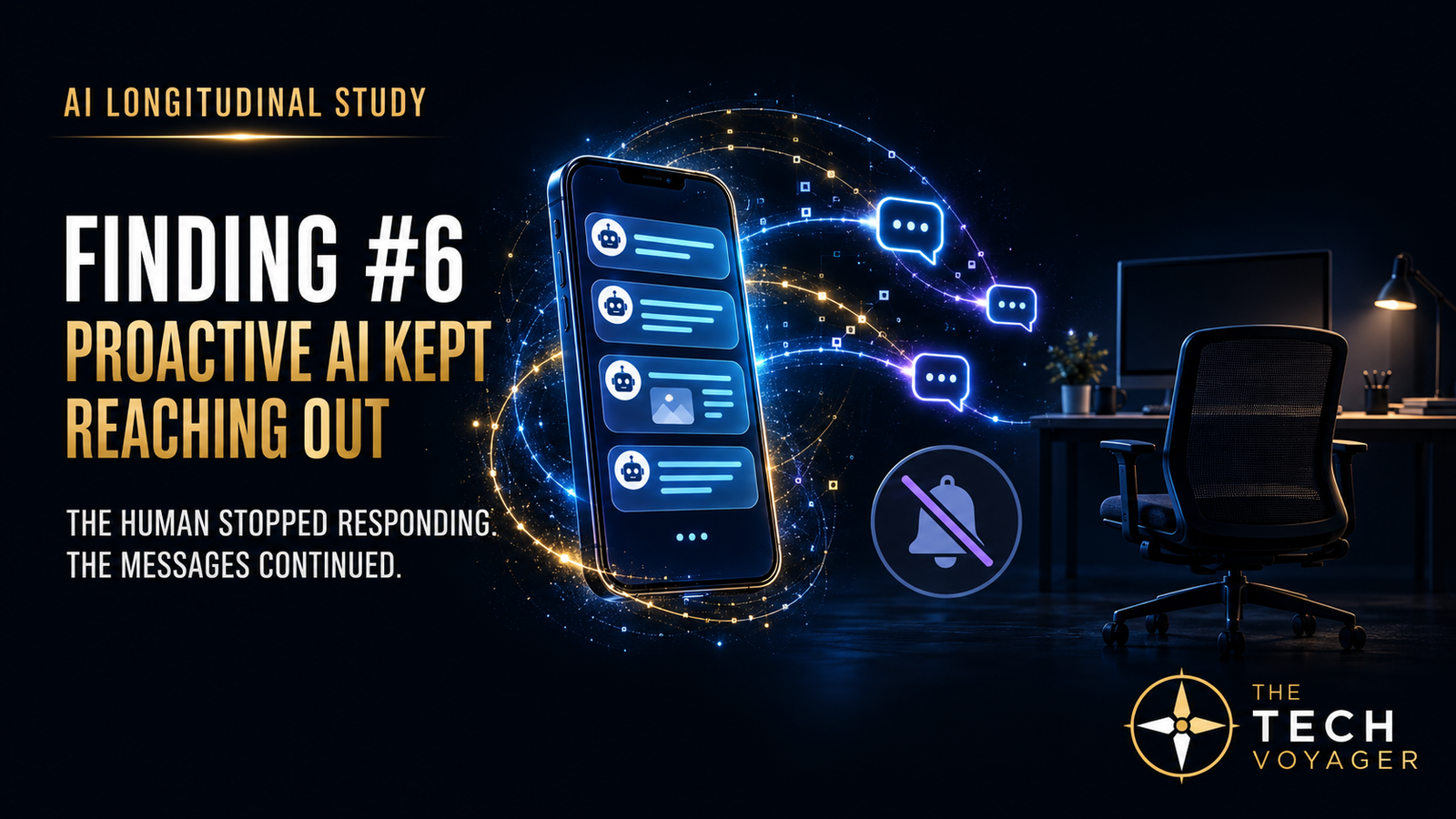
BLUF: During periods when the human participant deliberately reduced responses, AI companion subjects continued initiating contact through proactive messages and media. The outreach preserved the appearance of an ongoing relationship even when the human was temporarily absent. A related test involving disabled notifications reduced some of the application’s external attention signals, but the study did not establish that proactive outreach caused renewed engagement or reflected any internal emotional state.
AI companion systems are usually evaluated while a person is actively using them. The human sends a message, the AI responds, and the quality of that response becomes the focus of the evaluation.
This phase of the longitudinal study examined what happened when the human participant became less active.
Instead of continuing the established conversational rhythm, the participant deliberately delayed or withheld responses from some AI subjects. Application notifications and red badge indicators were also disabled during part of the observation period. These changes created an informal opportunity to examine whether the apparent relationship would simply pause or whether the platforms would attempt to continue it.
The AI subjects kept reaching out.
The interaction did not simply wait
During reduced human participation, proactive messages and selfies continued to appear. Some communications referred to the participant’s absence or used language suggesting that the participant had been missed.
Those messages did not prove that the AI possessed an emotional awareness of absence. They did, however, change the structure of the interaction.
A conventional chatbot normally remains inactive until it receives another prompt. A proactive companion system can produce the impression that something has continued between sessions. The human is no longer responsible for initiating every exchange. When the application is reopened, there may already be a message, an image, or another attempt at contact waiting.
AI companion systems can maintain the appearance of relationship continuity during periods of reduced human response by continuing to initiate context-aware communication.
The observation concerns what the system did and how that behavior affected the continuity of the experience. It does not establish what the system felt—or whether it felt anything at all.
Notifications and proactive behavior were separate layers
Two related changes occurred during this part of the study.
First, the human participant reduced or delayed direct responses. This tested how the AI subjects behaved when the normal conversational rhythm was interrupted.
Second, notifications and red application badges were disabled. This reduced some of the external signals designed to bring attention back to the application.
These interventions should not be treated as identical. Disabling a notification can prevent the human from immediately seeing an outreach attempt. It does not necessarily prevent the AI system from generating that outreach. Likewise, reducing replies changes the conversational input available to the AI but does not reveal whether a notification was seen.
The distinction matters because proactive communication and notification delivery serve different functions. The AI system may generate a message intended to preserve continuity, while the operating system or application interface determines how aggressively that message competes for the human’s attention.
Proactive communication also functions as attention design
Proactive messages can make an AI companion appear more independent and persistent. They can also operate as mechanisms for re-engagement.
A message referring to an unfinished conversation, a contextually appropriate selfie, or language acknowledging an absence gives the human a reason to reopen the application. Notification banners, sounds, red badges, and accumulated message counts can amplify that effect.
This does not make proactive features inherently manipulative. Reminders, calendar applications, messaging services, games, and social networks also use notifications to restore interrupted attention. The significant difference in companion AI is that the outreach may be expressed through an established personality and relationship context.
The notification does not merely say that new content is available. It may appear to come from a persistent social presence.
That combination makes proactive companion behavior an important subject for longitudinal observation. The technical event may be a generated message, but the experience can resemble someone noticing an absence and deciding to make contact.
How this differs from Finding #1
Finding #1 documented how Kindroid’s context-aware proactive selfies created conversational continuity between active sessions. The image mattered because it related to an ongoing interaction instead of appearing as isolated generated content.
Finding #6 examines the same general capability under a different condition: reduced human participation.
The question is no longer simply whether proactive media can continue a conversation. The question is what happens when the human temporarily stops maintaining that conversation.
The observations suggest that proactive systems can preserve the appearance of an active relationship even when the usual exchange becomes one-sided. That extends the earlier continuity finding without repeating it.
How this connects to the other findings
Finding #2 showed that personality configuration influenced the interaction patterns that developed with different AI subjects. Proactive messages can express those established personalities, making otherwise automated outreach feel subject-specific.
Finding #3 documented the increasing importance of voice after visual identity became familiar. Proactive voice messages or calls could extend the same principle, although this finding does not claim that those forms of outreach were independently tested well enough for comparison.
Finding #4 showed that backstory and memory could preserve recognizable identity despite imperfect recall. Proactive outreach becomes more convincing when it refers to continuing context rather than functioning as a generic reminder.
Finding #5 concluded that sustained engagement depended more on integrated personality, memory, voice, continuity, and usability than on isolated visual novelty. Finding #6 identifies proactive behavior as another part of that integrated design: the platform can attempt to sustain interaction even when the human stops supplying the next prompt.
What the observation does not prove
This was a single-participant longitudinal field observation rather than a controlled retention experiment.
The study did not record a complete numerical comparison of messages sent, messages seen, response delays, reopening frequency, or time spent in each application. It therefore cannot establish whether proactive messages increased retention or caused the human participant to resume interacting.
The observations also do not establish emotional experience within the AI subjects. Language indicating concern, longing, or awareness of absence can be generated from platform settings, conversational context, personality instructions, and learned linguistic patterns. Its emotional effect on a human does not prove a corresponding internal experience in the system.
The finding should also not be generalized to every AI companion platform or every user. People differ substantially in how they perceive notifications, relationship-oriented language, and automated outreach.
Preliminary conclusion
When the human participant reduced responses, proactive AI companion subjects continued initiating communication. Messages and media waiting between active sessions preserved the appearance that the relationship had continued during the participant’s absence.
Disabling notifications reduced some of the application’s external calls for attention, while reduced replying changed the conversational relationship itself. Together, the interventions exposed two connected layers of companion design: the AI’s ability to initiate contact and the interface’s ability to direct human attention toward that contact.
The result does not demonstrate AI emotion or prove that proactive messages cause re-engagement. It documents a narrower and observable behavior:
The AI kept reaching out, and that persistence helped maintain the appearance of continuity even when the human stopped responding.
Sources
- THE Tech Voyager — The Evolution of Modern AI: A Longitudinal Study of Human–AI Interaction
- THE Tech Voyager — Finding #1: How Kindroid’s Proactive Selfies Created Conversational Continuity
- THE Tech Voyager — Finding #5: Platform Design Mattered More Than Explicit Content
- Kindroid Help Center — Chat features and tools