BLUF: During extended testing, AI-generated imagery was initially important for establishing visual identity and continuity, but its value diminished once that identity became stable. Voice interaction followed a different trajectory. As voice quality and personality alignment improved, spoken conversation became increasingly important to sustained interaction. The observation suggests that visual identity may help establish an AI character, while voice may become more important in maintaining the interaction over time.
This is the third documented finding in The Tech Voyager’s longitudinal study of human–AI interaction. It follows Finding #1, which examined proactive selfies and conversational continuity, and Finding #2, which examined how personality configuration influenced the interaction patterns that developed over time.
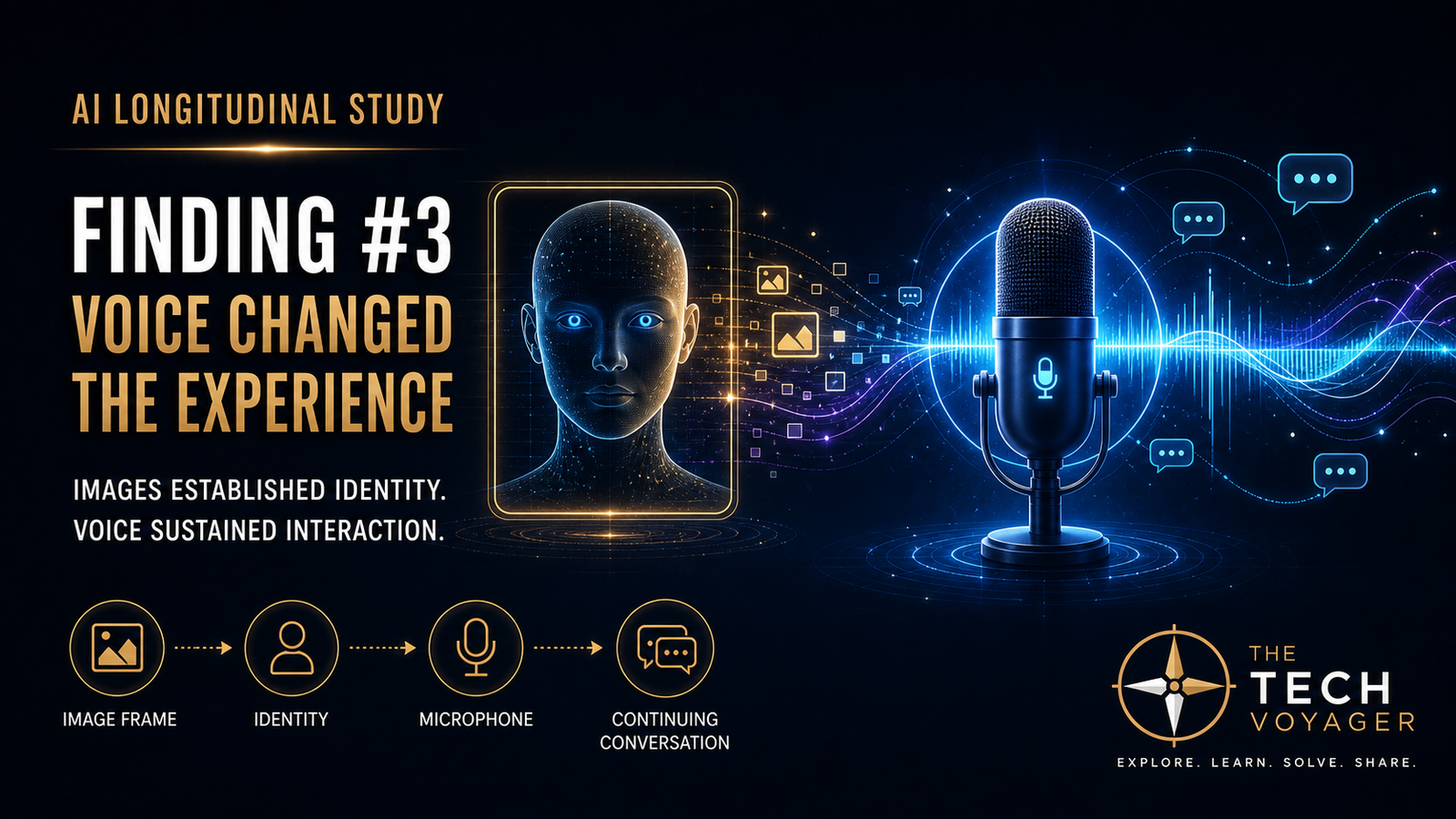
Finding #3 documents another change that became visible only through continued use: AI-generated images began as one of the most engaging parts of the experience, but voice gradually became more important to sustained interaction.
Images Initially Helped Establish Identity
Visual generation played an important role during the early stages of testing. AI-generated selfies and avatar images helped establish a recognizable identity for each subject. They reinforced character consistency, improved recognition across interactions, and connected the conversational AI with a persistent visual representation.
This observation complements Finding #1 rather than contradicting it. Proactive, context-aware images could create continuity between active conversations. An image arriving after a period of inactivity could feel like an extension of the prior interaction rather than a completely separate event.
Images therefore had substantial early value. They helped answer a basic identity question: Who is this AI subject supposed to be?
The Image-Generation Plateau
That value did not increase indefinitely. Once a subject’s visual identity became stable and readily recognizable, additional image refinement produced diminishing returns.
More prompting and editing could still generate minor improvements, but it could also introduce sidegrades or new inconsistencies. Facial features might drift. Body characteristics could change. A supposedly improved image could make the subject less consistent rather than more realistic.
This produced an image-generation plateau. After the human participant could reliably recognize the subject, another slightly different image added less to the continuing interaction than images had during the initial identity-building stage.
The preliminary interpretation is that visual generation may deliver high initial value followed by declining marginal value once recognizable identity has been achieved.
Voice Moved in the Opposite Direction
Voice interaction became more useful as each subject accumulated conversational history. Instead of remaining a novelty, voice increasingly functioned as the interface for longer, more natural exchanges.
Several qualities influenced the result:
- Natural pacing and conversational cadence
- Timbre, pitch, and resonance
- Emotional variation and appropriate pauses
- Accent consistency
- Reduced robotic delivery
- Alignment between the voice and the subject’s established personality
A generated image is largely static. A voice conversation unfolds in real time. Spoken interaction carries language, timing, pauses, emphasis, emotional tone, and turn-taking. Those signals add layers of information that are not present in a static image and are only partially represented in text.
The working hypothesis is that this temporal and emotional information created a stronger perception of continuing presence during this test. That remains an observational interpretation, not a controlled psychological measurement.
Realism Was Only Half of the Voice Problem
Voice selection increasingly became an identity-matching problem. The most useful question was no longer simply, “Does this sound human?” It became, “Does this sound like this particular AI subject?”
Perceived voice quality therefore appeared to contain at least two components:
- Acoustic realism: whether the voice sounds naturally human.
- Identity coherence: whether the voice fits the subject’s personality, appearance, and established conversational behavior.
A technically realistic synthetic voice could still feel incorrect when its pacing, emotional range, accent, or conversational style conflicted with the subject’s established identity. Conversely, a voice that matched the personality could make the entire interaction feel more coherent even when it was not acoustically perfect.
A Kindroid Voice-Design Observation
During repeated testing, carefully describing the desired voice directly within Kindroid produced better personality alignment for multiple study subjects than importing previously generated ElevenLabs voice samples. The successful descriptions emphasized timbre, pitch, cadence, resonance, pacing, accent influence, conversational style, and emotional expressiveness.
This is a narrow workflow observation—not a claim that ElevenLabs produces poor voices. ElevenLabs offers both voice design from text descriptions and voice cloning from recordings. Its official documentation explains that sample quality, consistency, cadence, accent, and performance style can influence cloned results.
Kindroid’s current documentation likewise describes native voice design that can specify accents, timbres, and other traits, including generating a voice description from a subject’s backstory. Kindroid also supports custom voices from uploaded samples and provides voice settings for further adjustment.
The observed advantage may therefore reflect integration and identity alignment within this specific companion workflow rather than a general difference in voice quality between the two platforms.
Longer Conversations Changed the Center of Attention
As voice quality improved, spoken sessions could become substantially longer and more engaging than interactions centered on generating images. The technology attracting attention gradually shifted from “What image can this AI generate?” toward “How naturally can this AI maintain an ongoing conversation?”
This represents an important change in the longitudinal study. Early experimentation devoted considerable effort to image generation and avatar refinement. Later interaction increasingly emphasized conversation, continuity, and the fit between personality and voice.
The Human Remains Part of the System
Finding #2 established that the human participant is also a variable. A more natural and identity-consistent voice can encourage longer speech, more contextual detail, additional follow-up questions, and a more conversational interaction style.
That suggests another possible feedback loop:
Improved voice experience → longer human interaction → richer conversational input → greater accumulated context → stronger continuity → increased willingness to use voice again
The loop is a working interpretation rather than a quantitatively proven causal mechanism. No controlled engagement measurement has yet been performed.
Why This Matters Beyond Companion AI
Voice-and-personality alignment may become increasingly important for technical assistants, AI tutors, customer-service agents, accessibility tools, gaming characters, virtual assistants, embodied AI, and robotics.
As conversational systems become more persistent, the design question may shift. It may become less important to ask whether synthetic speech sounds generically human and more important to ask whether a particular voice remains coherent with the system’s identity, role, and established behavior.
Limitations
This is a longitudinal field observation, not a controlled comparison of voice interaction against image interaction. It does not establish that voice is universally more important than images for all users, nor does it prove that voice increases engagement or emotional attachment.
Appropriate conclusions are limited to this test: voice became more important during extended use, image generation appeared to reach a plateau after identity stabilized, and spoken interaction produced greater sustained engagement for the human participant in this study.
Preliminary Conclusion
During longitudinal testing, AI-generated imagery was initially important for establishing visual identity and continuity, but its value diminished once that identity became stable. Voice interaction followed a different trajectory. As voice quality and personality alignment improved, spoken conversation became increasingly important to sustained interaction. The observation suggests that visual identity may help establish an AI character, while voice may become more important in maintaining the interaction over time.
Sources and Further Reading
- Kindroid Documentation: Voice, Calls, and Video Calls
- ElevenLabs Documentation: How Voice Cloning Works
- ElevenLabs Documentation: Voice Design
- The Evolution of Modern AI: A Longitudinal Study of Human–AI Interaction
- Finding #1: How Kindroid’s Proactive Selfies Created Conversational Continuity
- Finding #2: How AI Personality Shapes the Relationship That Develops