BLUF
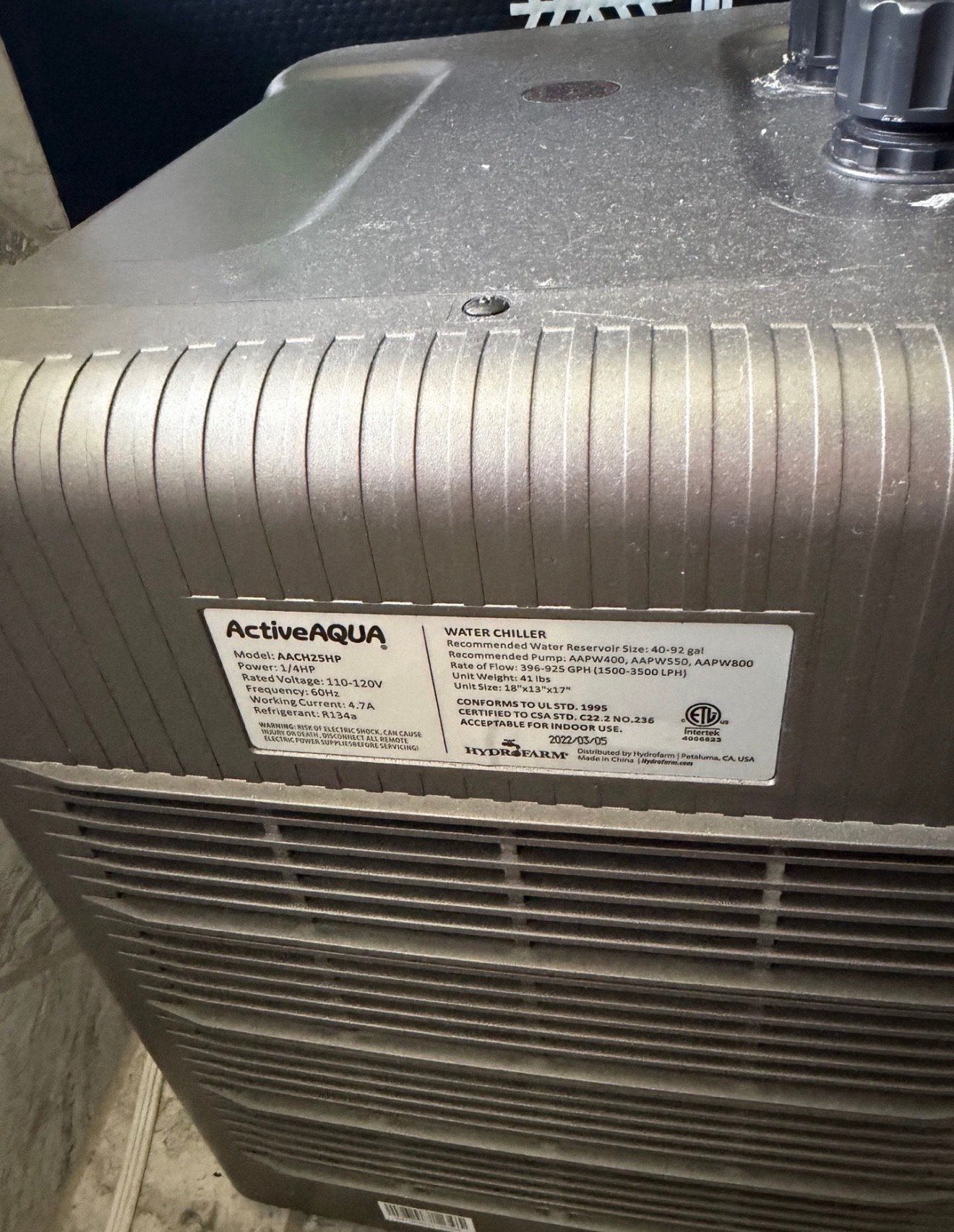
My first PlungIT system was oversized: a half-horsepower chiller paired, as I remember it, with an Active Aqua pump rated around 1,000 gallons per hour. The combination that ultimately made more sense for the one-person tub was a quarter-horsepower Active Aqua AACH25HP chiller and an Active Aqua 800 GPH pump. The lesson was not that smaller is always better. It was that the tub, water volume, pump, fittings, hoses, ambient conditions, and chiller must be treated as one system.
I Initially Bought More Capacity Than I Needed
When I began experimenting in 2023, I assumed additional chiller and pump capacity would give me more flexibility. That sounds reasonable until the parts are connected to a specific amount of water through real hoses and fittings.
The one-person inflatable was planned for approximately 72–75 gallons. The larger tub held roughly 105–115 gallons. Those two vessels were not interchangeable from the chiller’s point of view: additional water changes cooling time, total filled weight, circulation needs, and the heat entering the system.
The half-horsepower chiller worked, but it was more machine than the one-person product needed. The same was true of the roughly 1,000 GPH pump. As the product became better defined, I stepped both components down.
Why the Quarter-Horsepower Chiller Fit
The final chiller was the Active Aqua AACH25HP. The manufacturer lists a recommended reservoir range of 40–92 gallons, which covered the one-person tub’s estimated 72–75 gallon capacity. It also specifies a recommended flow range of 396–925 GPH and names the Active Aqua AAPW800 among the recommended pumps.
That documentation matches my practical conclusion: the quarter-horsepower chiller and 800 GPH pump were a sensible pair for the one-person PlungIT.
It does not mean every nominal 75-gallon vessel will perform identically. Ambient temperature, insulation, fill level, hose length, flow restriction, starting water temperature, sunlight, and how often the lid is removed all affect the result.
What My Cooling Test Recorded
One surviving test used approximately 50 gallons of water in a room around 72°F. With the half-horsepower chiller, the water took about one hour and 55 minutes to fall from 65°F to 55°F. A separate entry recorded that moving from 48°F to 40°F took approximately six additional hours.
Those numbers are historical observations, not laboratory specifications. They do show something useful: cooling is not linear. The last few degrees can require considerable time because heat continues entering from the room while the chiller is removing it.
This is also why a single claim such as “reaches 40 degrees” tells a buyer very little. A responsible performance description should state the water volume, starting temperature, ambient conditions, insulation, equipment, and approximate elapsed time.
The Pump Was Not an Accessory
I originally thought mostly about refrigeration. In practice, the pump was just as important.
The chiller can only remove heat from water that reaches it. Insufficient circulation produces uneven temperatures and poor heat transfer. Excessive or poorly managed flow can create its own problems at fittings and caps. Every hose, bend, reducer, filter, and connection adds resistance, so the number printed on a pump is not necessarily the flow that reaches the tub.
The 800 GPH pump fit within the chiller manufacturer’s stated flow range while giving the one-person system continuous circulation. That matched the equipment on paper and behaved better in my assembled system.
What I Would Measure Today
If I repeated the project, I would document each configuration as a testable system:
- actual water volume rather than maximum tub capacity;
- starting and target temperatures;
- indoor or outdoor ambient temperature;
- cooling time at regular intervals;
- pump model and rated flow;
- hose diameter, length, insulation, and number of restrictions;
- temperature at multiple points in the tub; and
- electrical consumption over a complete cooling cycle.
That record would make comparisons more meaningful and customer expectations much easier to manage.
The Lasting Lesson
I began with the understandable idea that a larger chiller and stronger pump would be safer choices. What I learned was more useful: size components to the real vessel and the real plumbing.
The quarter-horsepower chiller and 800 GPH pump were not compromises. For the one-person PlungIT, they were the more coherent system.
Part of the PlungIT archive. Read the complete pillar story, the bathtub origin, and the preceding chapter about my 2023 cold-plunge diary. Next: fittings, pressure, circulation, and the leaks I had to solve.