BLUF
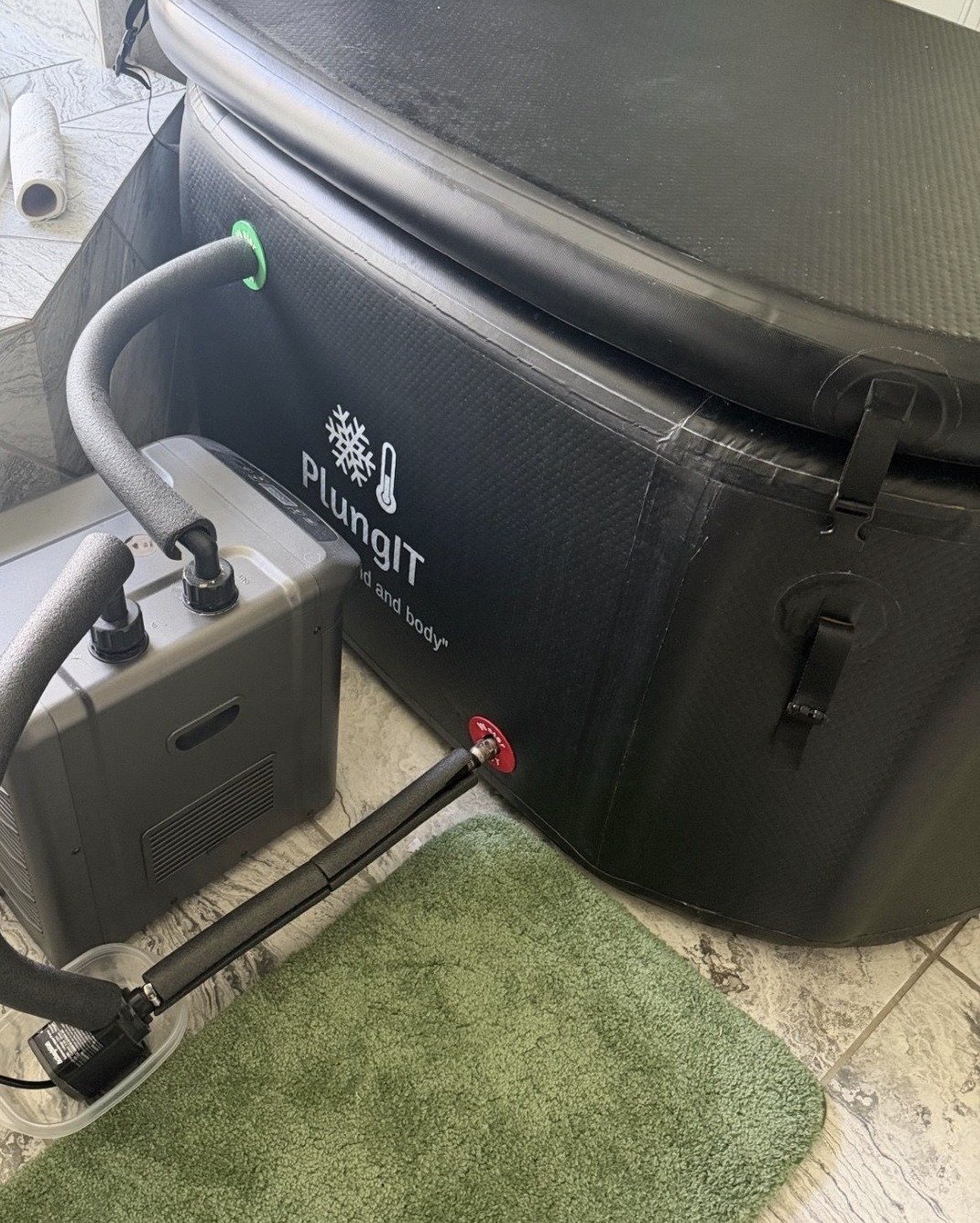
In 2023, when complete cold-plunge systems were commonly selling for thousands of dollars, I decided to see whether I could engineer and source a practical inflatable alternative myself. What began as a personal cold-water experiment became PlungIT: a portable one- or two-person tub connected to a chiller, pump, insulated hoses, and fittings. I sourced tubs from China, tested temperatures and cooling times, worked through leaks and water-pressure problems, and sold roughly a dozen units—mostly through eBay.
The sourcing lesson was blunt: buying directly from China can reduce the visible unit price, but unless you purchase enough volume, shipping, components, marketplace costs, support, and troubleshooting can erase the advantage. Small-volume sourcing did not produce sustainable margins for me.
It was a real product, and customers were satisfied, but it was not a profitable business. I invested roughly $1,500 and estimate that I recovered around 60–70% of it. On August 15, 2026, I sold the final complete branded system locally in San Antonio for $400. The project taught me more about product development, circulation, fittings, warranties, marketing claims, and cold-water safety than I expected.
This is the documented story of what I built, what worked, and what I would describe more carefully today.
Why I Started
Cold plunging was becoming increasingly popular in early 2023. Complete systems were sometimes priced around $3,000, and my first reaction was practical: an inflatable tub, a water chiller, a pump, and some plumbing should not have to cost that much.
My interest was personal as well as commercial. I was actively doing CrossFit, and my wife was training too. I wanted to see whether cold immersion might help my post-workout recovery. I also hoped it might help with my migraines and some symptoms associated with PTSD.
For my digital record, one outcome matters to me: my migraines eventually went away. That is my personal chronology, not proof that cold plunging caused the change, and it should not be read as a treatment claim. I am not claiming that cold immersion treats or cures migraines or PTSD.
At the time, I operated as Mike the IT Guy. I was comfortable researching products, troubleshooting systems, and dealing directly with overseas sources. I decided to find an inflatable manufacturer in China and work backward from the experience I wanted: a durable, portable cold plunge that could accommodate either one person or two.
I also discovered that direct sourcing was not automatically cheap in practice. Without a meaningful volume order, the economics worked against me. The cost of a small batch had to absorb freight, chillers, pumps, fittings, hoses, marketplace fees, testing, and customer support. The factory price was only one part of the real cost.
The idea was not to sell an empty container and leave the buyer to solve the rest. The meaningful product was the complete system:
- an insulated inflatable tub;
- a fitted lid;
- a properly sized water chiller;
- a circulation pump;
- insulated hoses;
- inlet and outlet fittings; and
- the practical knowledge required to keep it circulating without leaking.
That last item became more important than I anticipated.
I Tested Cold Plunging on Myself First
The written log is not the true beginning. In January 2023, while I was waiting for the inflatable tubs to arrive from China, my wife and I started testing with a chiller connected to our household bathtub. The water was around 60°F at first. We were both doing CrossFit, and the setup felt useful to us for post-workout recovery. At the time, we described that subjectively as helping with post-workout inflammation, but we did not clinically measure inflammation and I am not presenting that impression as a medical finding.
Those bathtub tests gave us enough confidence to continue. They also produced videos that remain in my private archive. Their existence matters to the chronology, but they should not be made public unless I explicitly approve their use.
My surviving written notes begin on February 20, 2023, after the January bathtub tests. I started at two minutes, three days a week, in water at or below roughly 52°F. The early sessions caused serious headaches. I recorded the reaction plainly because it was impossible to ignore.
The headaches eventually stopped, but they changed the meaning of the experiment. Cold immersion was not simply an invigorating lifestyle trend. It was a substantial physiological stressor, and my response was not something a responsible article should hide.
Over the following weeks, I gradually increased the exposure:
| Week beginning | Recorded exposure | Recorded temperature/frequency |
|---|---|---|
| February 20, 2023 | 2 minutes | At or below about 52°F; Monday, Wednesday, Friday |
| February 27 | 2½ minutes | Tuesday and Thursday; headaches still noted |
| March 6 | 2½ minutes | Friday |
| March 13 | 2½–3 minutes | Monday, Wednesday, Friday |
| March 20 | 3 minutes | At or below about 52°F; four sessions recorded |
| March 27 | 4 minutes | At or below about 52°F; Monday, Wednesday, Friday |
| April 3 | 4½ minutes | At or below about 50°F; Monday, Wednesday, Friday |
| April 10 | 5 minutes | At or below about 50°F; Monday and Wednesday |
| April 17 | 5 minutes | Four sessions recorded |
| April 24 | 5½ minutes | Four sessions recorded |
| May 1 | 5½ minutes | One session recorded |
This table is my historical log, not a recommended protocol. Current evidence does not establish one universal temperature-and-duration formula for every goal or every person. Cold immersion can produce an abrupt cold-shock response, including rapid changes in breathing, heart rate, and blood pressure. Anyone with medical concerns should discuss the practice with a qualified clinician rather than treating my log as instructions.[1]
Turning an Experiment Into a Product
The archive becomes visually dense in March 2023. Photos show tubs, ports, valves, measurements, hoses, pumps, temperature readouts, brand mockups, and test setups. Those images are not merely product photography. Together they show the process of translating an idea into specifications.
The documented one-person design measured approximately:
- 51.97 inches long;
- 27.56 inches wide;
- 24.41 inches deep;
- 72–75 gallons when filled to the planned level; and
- about 22 pounds empty.
The larger design was approximately 77 inches long and held roughly 105–115 gallons. It offered more room, but the additional water changed the cooling load, filled weight, portability, and chiller requirements.
That was one of the project’s recurring lessons: a tub dimension is not just a comfort specification. It affects nearly everything downstream.
The Chiller Was Only Half the Problem
My early system was oversized. It included a half-horsepower chiller and, as I remember it, an Active Aqua pump rated at approximately 1,000 gallons per hour. I later moved down to a quarter-horsepower chiller and an Active Aqua 800 GPH pump. That smaller combination was the best fit for the one-person system I was refining.
The final chiller was an Active Aqua AACH25HP. Its manufacturer lists a recommended reservoir range of 40–92 gallons, a 396–925 gallon-per-hour flow range, a maximum pressure rating of 10 psi, and the Active Aqua AAPW800 among its recommended pumps.[2] That reservoir range aligns well with the one-person tub’s estimated 72–75 gallon capacity, and the manufacturer’s pump recommendation supports why the 800 GPH configuration worked better as a matched system.
My notes contain a practical cooling test with approximately 50 gallons of water. In an indoor environment around 72°F, the half-horsepower chiller took about 1 hour and 55 minutes to bring the water from 65°F to 55°F. A separate test recorded that dropping from 48°F to 40°F took approximately six more hours. Those are historical observations from my setup, not controlled laboratory results. Ambient temperature, starting water temperature, water volume, insulation, pump flow, and heat entering through the room all matter.
The manufacturer makes the same general point: starting ambient temperature affects the duration of the initial chilling process.[2]
Why the Tub Leaked—and What Finally Worked
Many of the archive’s close-up photographs show damp areas, valves, caps, and improvised test arrangements. I took them because I was chasing a real problem.
At first, the inflatable connections appeared to leak under water pressure. I worked through the fittings, measured the ports, tested caps and hoses, and paid attention to what changed when the pump was running. My practical conclusion was that the system needed continuous water movement. Once I kept the water circulating, the setup performed well.
That is my firsthand engineering observation, not a universal claim that circulation cures every leak. Some leaks come from damaged seals, incorrect fittings, excessive pressure, loose connections, over-tightened parts, or physical damage. The historical manufacturer warnings also advised buyers not to over-tighten the caps, move the tub while full, overinflate it, expose it excessively to sun, or allow sharp objects near it.
The larger lesson is more durable: components cannot be evaluated separately. Tub geometry, fitting size, pump flow, hose resistance, chiller limits, and pressure all form one system. A cheap tub plus an expensive chiller is still a bad product if the plumbing is mismatched.
From Prototype to Sales
PlungIT moved beyond a garage experiment. I had branded one-person tubs produced and sold roughly a dozen units, primarily through eBay. My recollection is that the customers were satisfied.
The customer handout thanked buyers for supporting a local business and included setup and handling warnings. The shipped package could include the inflatable tub, hand pump, repair kit, and carrying bag. Complete systems also included the cooling and circulation equipment.
The surviving records show how the offer changed over time. Early notes mention a three-year tub warranty. A later eBay listing offered a one-year warranty. Those policies should not be blended together as though the same warranty applied to every unit.
The final known eBay sale occurred on July 5, 2025. That transaction was for the tub package only—not a chiller system:
- sale price: $100;
- buyer total with shipping: $131.84;
- PVC inflatable tub;
- pump, repair kit, and carrying bag;
- listed dimensions of 59 × 24 × 24 inches; and
- one-year warranty.
The Economics Were Modest
By my rough accounting, I invested about $1,500 and recovered perhaps 60–70% of it. The project therefore ended at a loss.
That may sound anticlimactic, but it is part of the value of preserving the story. A product can be technically workable, reach paying customers, and leave those customers satisfied without becoming a sustainable business. Small-batch importing, shipping, components, replacements, marketplace fees, and the time spent troubleshooting can consume a margin quickly.
I proved that a functional system did not have to cost $3,000. I did not prove that I could profitably manufacture, support, and distribute it at scale.
The Final PlungIT Sale
In August 2026, more than three years after my first documented plunge, I listed the final complete branded unit on OfferUp in San Antonio.
The one-person system was described as approximately two years old, kept indoors, clean, and fully operational. The package included:
- the insulated PlungIT tub;
- its fitted insulated lid;
- the Active Aqua AACH25HP quarter-horsepower chiller;
- a water pump;
- insulated circulation hoses and connections; and
- chlorine and spa-water maintenance supplies.
I listed the setup for $550. It sold locally for $400 on Saturday, August 15, 2026.
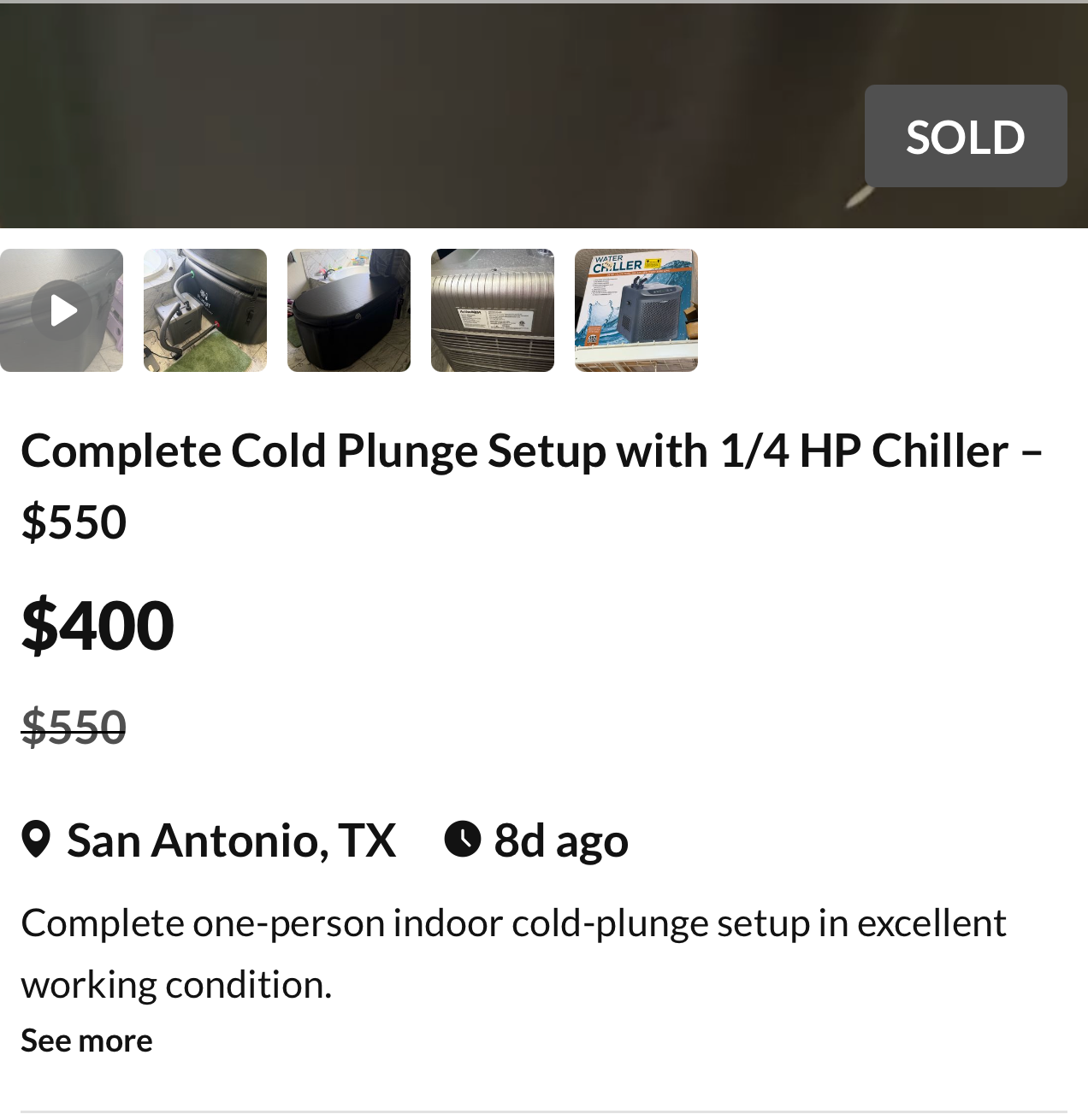
That sale closed the physical chapter of PlungIT. The system that remained at the end still expressed the original idea: an integrated, one-person plunge that combined portability with active cooling and circulation.
What the Evidence Supports—and What It Doesn’t
The old marketing notes included sweeping language about circulation, inflammation, immunity, mental clarity, mood, skin health, and sleep. I would not publish those statements today as settled fact.
The evidence is narrower and more nuanced:
- Cold-water immersion can help reduce perceived muscle soreness after strenuous exercise, and several reviews find benefits for some short-term recovery outcomes.[3][4]
- That does not make it a universal performance enhancer. Regular cold immersion used alongside resistance training may reduce some long-term strength adaptations, so timing and purpose matter.[5]
- A 2025 review of general health and wellbeing found limited, time-dependent results and emphasized the small number of trials, small samples, and lack of diverse participants. It did not support treating broad claims about immunity, mood, or inflammation as certain.[6]
- Cold water acutely stresses the cardiovascular and respiratory systems. The initial shock can rapidly change breathing, heart rate, and blood pressure.[1][7]
In other words, “it made me feel alert” is a legitimate personal observation. “It boosts everyone’s immune system” is a medical claim requiring evidence that the current literature does not firmly provide.
My own headaches are another reason to keep that distinction clear. They resolved, but their appearance was a warning that individual responses differ.
What I Would Tell Someone Building One Today
First, decide what problem you are solving. A recovery tool, a personal ritual, and a commercial product require different evidence and different engineering.
Second, size the system as a system. Match water volume, pump flow, fitting diameter, hose resistance, chiller range, insulation, and expected ambient conditions. The quarter-horsepower unit was sensible for my 72–75 gallon one-person tub because its documented reservoir range covered that volume.[2]
Third, do not confuse colder with automatically better. Temperature and exposure time should serve a defined purpose, and the safest useful protocol may not be the most dramatic one.
Fourth, document failures. The leak photos, temperature readings, and awkward prototypes are more valuable now than polished marketing images because they show how the design actually evolved.
Finally, be careful with health claims. Sell what you can demonstrate: dimensions, materials, included equipment, flow requirements, cooling performance under stated conditions, and your own experience. Qualify everything else.
What Remains
Mike the IT Guy is no longer my business. Today I use the trademarked identity THE Tech Voyager™, and my name is Michael Johnstone.
PlungIT did not become a major brand, but it was not imaginary or unfinished. It moved from an idea to drawings and specifications, from overseas sourcing to physical prototypes, and from testing to paying customers. The final system remained operational long enough to find a new owner in 2026.
That is why I wanted to preserve this archive. Digital legacy is not only a record of successes. It is also a record of the questions we asked, the things we made, the problems we solved, and the honest limits of what came from them.
PlungIT Series
This pillar is the complete overview of the PlungIT project. The supporting chapters preserve the personal experiments, engineering decisions, sourcing lessons, customer experience, and final sale in greater detail:
- Before PlungIT, There Was a Chiller in My Bathtub
- What My 2023 Cold-Plunge Diary Actually Recorded
- How I Matched a Cold-Plunge Chiller and Pump to the Tub
- Why My Inflatable Cold Plunge Leaked—and Why Circulation Mattered
- Sourcing PlungIT From China: Why the Factory Price Wasn’t the Real Cost
- One-Person, Two-Person, and Tub-Only: What Selling PlungIT Taught Me
- The Final PlungIT Sale: Closing a Project Three Years Later
Sources
- American Heart Association — “You’re not a polar bear: The plunge into cold water comes with risks”
- Hydrofarm — Active Aqua Chiller with Power Boost, 1/4 HP (AACH25HP)
- Batista et al. — Updated systematic review and meta-analysis of cold-water immersion and muscle soreness
- Moore et al. — Systematic review and meta-analysis of cold-water immersion after strenuous exercise
- Malta et al. — Systematic review and meta-analysis of regular cold-water immersion during training
- Cain et al. — Systematic review and meta-analysis of cold-water immersion, health, and wellbeing
- Jdidi et al. — Systematic review and meta-analysis of cardiovascular and autonomic responses to cold exposure