Sometimes Technology Solves the Wrong Problem
I recently ran into one of those moments that perfectly captures modern technology.
I was creating another episode in my Movies That Hit Different series for YouTube. This one was about The Shawshank Redemption, and I wanted a single still image to accompany my commentary under what I believe is fair use.
Simple enough, right?
Not exactly.
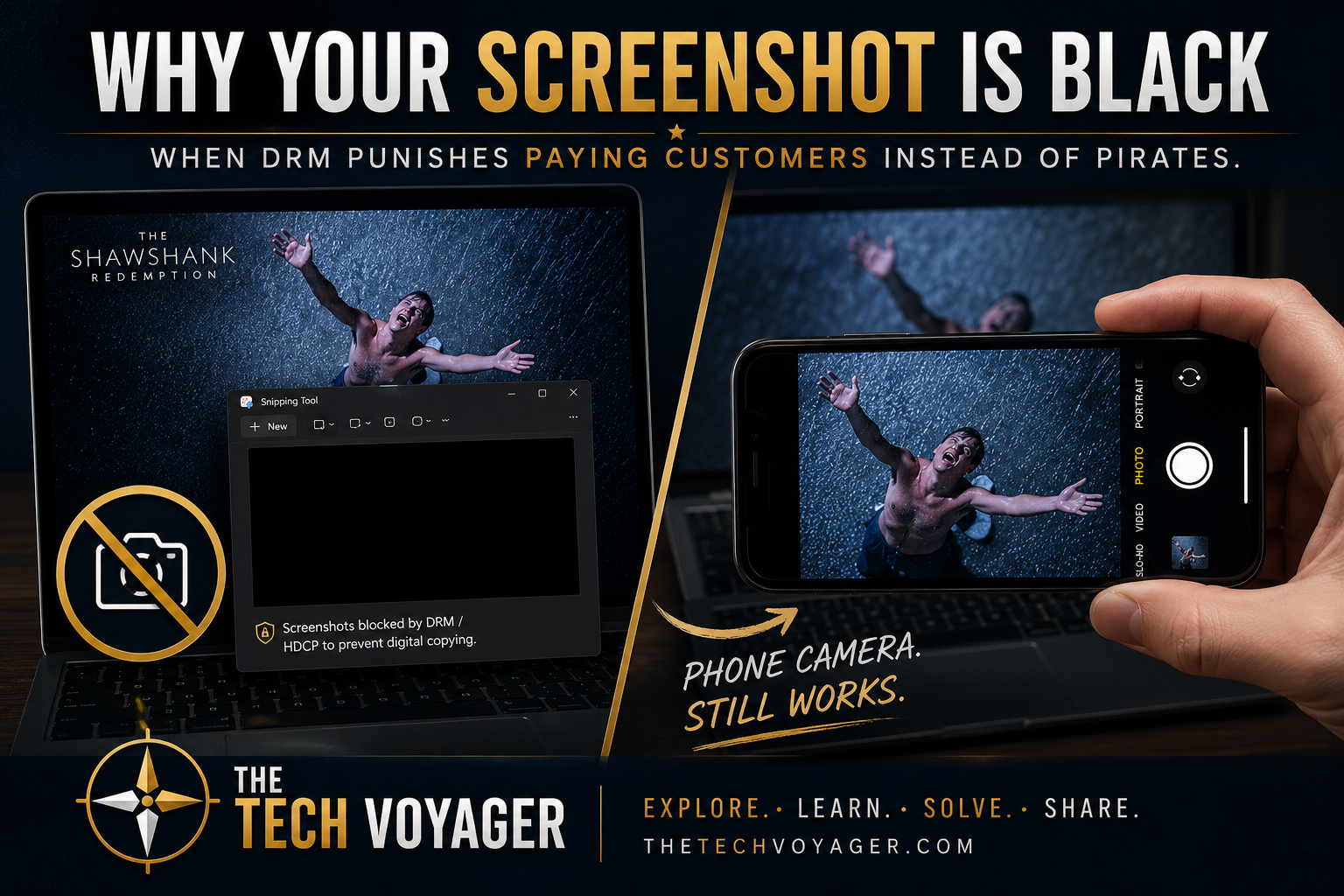
I own the movie legally in my Fandango at Home library. I opened it on my laptop, paused at the scene I wanted, pressed the screenshot shortcut…
…and the result was nothing but a black rectangle.
I tried again.
Black screen.
Different capture method.
Black screen.
Different application.
Still black.
For a moment I thought something was wrong with Windows.
The Unexpected Solution
Then I laughed.
I grabbed my phone, pointed it at the laptop display, took a picture, and suddenly I had exactly the image I needed.
The DRM that completely blocked screenshots couldn’t stop… a camera.
That’s when I realized the protection wasn’t really preventing someone from obtaining the image. It was simply making life harder for someone who had already paid for the movie.
Why Were My Screenshots Black?
This behavior is almost certainly caused by modern Digital Rights Management (DRM) systems working together with hardware-based copy protection.
Streaming services commonly use technologies such as Microsoft PlayReady, Google Widevine, or Apple’s FairPlay. Combined with HDCP (High-bandwidth Digital Content Protection), they can tell Windows and your graphics hardware not to allow protected video frames to be copied into screenshots or screen recordings.
When screenshot software tries to capture the protected video frame, the DRM system often replaces it with a blank or black image.
From the software’s perspective, everything is working exactly as intended.
So Why Did My Phone Work?
Because DRM only controls the digital signal inside your computer.
Once those pixels become actual light coming off your monitor, the computer has no control over what happens next.
A phone camera isn’t reading protected video data.
It’s simply photographing light.
It’s the digital equivalent of someone standing in front of a television with a camera.
The DRM can’t stop physics.
Why Streaming Services Do This
To be fair, streaming companies aren’t trying to make customers miserable.
Studios license movies with strict requirements designed to reduce high-quality copying and unauthorized redistribution. DRM exists because content owners want to protect their intellectual property and discourage perfect digital copies from spreading online.
That’s a reasonable goal.
Most people would agree creators deserve to be paid for their work.
The problem is that these protections often affect legitimate customers far more frequently than determined pirates.
When Protection Creates Friction
In my case, I wasn’t trying to upload the movie.
I wasn’t recording the film.
I wasn’t bypassing encryption.
I simply wanted a single frame from a movie I legally purchased so I could discuss it in a short video.
Instead, I spent several minutes troubleshooting before discovering that the simplest solution was pointing another camera at the screen.
Nothing about that experience improved security.
It simply added friction.
The Real Question
Technology should make legitimate customers’ lives easier.
When it doesn’t, it’s worth asking whether the implementation is accomplishing its intended goal.
Modern DRM certainly raises the barrier against casual copying.
But it also creates countless small frustrations for the people who actually bought the content.
Meanwhile, anyone determined to capture an image can often find another method.
Sometimes it’s sophisticated.
Sometimes it’s as simple as using a phone camera.
Official References
- Fandango at Home Help Center
- Movies Anywhere Help Center
- Microsoft PlayReady
- Google Widevine
- Apple FairPlay Streaming
Lessons Learned
- Black screenshots from streaming services are usually caused by DRM and HDCP protections—not a broken computer.
- DRM protects digital video streams but cannot prevent someone from photographing a display.
- Content protection serves a legitimate purpose, but thoughtful implementation matters just as much as security.
- Real-world user experience should always be considered alongside copyright protection.
Final Thoughts
I’m not arguing that copyright protection should disappear.
Artists, filmmakers, and studios deserve to protect their work.
What surprised me was how the technology ended up inconveniencing someone who had done everything the right way.
I bought the movie. I wasn’t redistributing it. I wanted one still frame for commentary.
The software said “No.”
My phone said, “Sure.”
Sometimes the most interesting technology stories aren’t about bugs—they’re about systems working exactly as designed, while leaving everyday users wondering if there’s a better balance between protection and usability.
Have you ever run into a piece of technology that made life harder for legitimate customers than for everyone else? I’d love to hear your experience.