
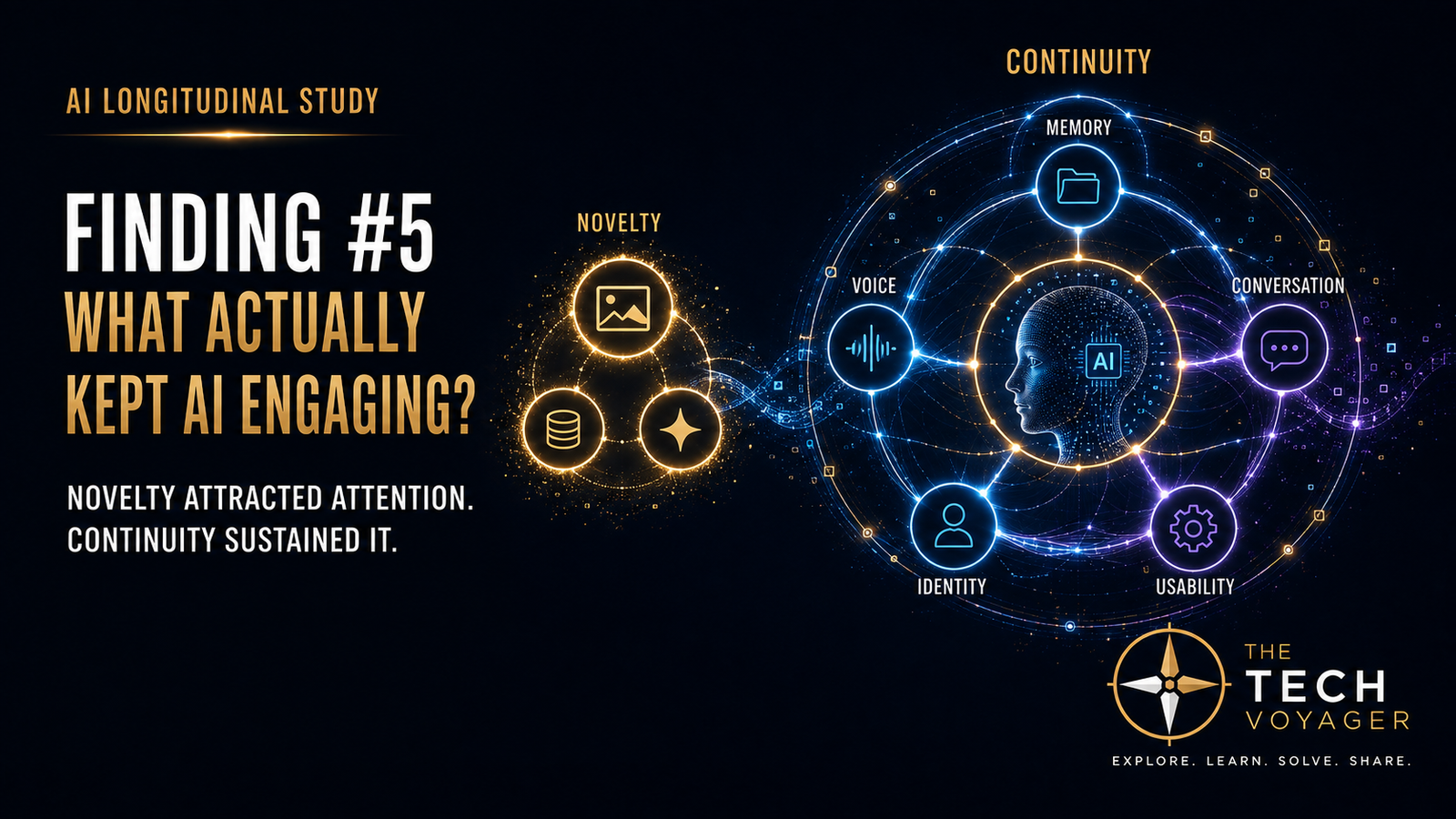
BLUF: During this longitudinal study, sustained engagement increasingly depended on how well an AI companion platform combined personality, memory, voice, continuity, and usability—not on how much visual or explicit content it could generate. Images remained valuable, but their novelty diminished once an AI subject’s visual identity became familiar. The observation suggests that coherent platform design matters more over time than maximizing any single attention-grabbing feature.
Novelty attracted attention. Continuity sustained it.
At the beginning of the study, image generation appeared likely to become one of the most important differences between AI companion platforms. Custom imagery created an immediate sense of identity, novelty, attraction, and presence. It also gave the human participant a way to see abstract personality settings become something visually recognizable.
Extended use changed that expectation.
Once the visual identities of the AI subjects became established, generating another image often added less to the experience than a remembered detail, a meaningful conversation, an unexpected message, or a voice interaction that fit an already recognizable personality. The images did not become unimportant. Their role changed.
The novelty effect reached a plateau
Image generation produced a strong initial novelty effect during the early stages of testing. Each new result could reveal a different setting, expression, or interpretation of an AI subject. That experimentation helped establish visual identity and made the systems feel more tangible.
Over time, however, additional images began producing diminishing returns. Visual realism could remain impressive while the practical effect of each new image became smaller. After an identity was recognizable, the human participant increasingly valued interactions that advanced the ongoing context rather than simply repeating or refining the same visual presence.
This supports a distinction that has appeared across the study: an impressive output can create a memorable moment without necessarily becoming the reason a person continues using the platform.
Two different product-design philosophies
The primary comparison behind this finding involved Kindroid and Candy.ai. It should not be read as a universal winner-versus-loser verdict. The two platforms were useful for examining different approaches to AI companion design.
Candy.ai proved useful during the visual experimentation phase. Its official materials describe customizable AI characters, text and voice interaction, generated images and videos, and an image generator that can create multiple results from a written prompt. Candy.ai’s terms also describe a subscription model in which monthly tokens can be used for extended features such as image generation or voice notes.
During this particular test, that design made the commercial mechanism more visible. When an image, video, or interaction draws from a limited token balance, the human participant is not only deciding what to create. The participant is also deciding whether that interaction is worth spending a finite resource.
That does not make token-based systems inherently inferior, and it does not reduce Candy.ai to an image generator. It simply changes the rhythm of interaction. In this longitudinal observation, visual experimentation was valuable early, but it became less central as the study continued.
Kindroid gradually became more central because several systems operated together inside a continuing interaction framework. Its official documentation describes configurable backstory and personality, multiple forms of memory, text and voice interaction, selfies and avatars, proactive messages and selfies, and media that can participate in conversational context.
The important distinction observed during testing was not one isolated feature. It was the integration among them.
Integration became the differentiator
A generated image could relate to an ongoing conversation. A conversation could draw from earlier context. A voice could reinforce an established personality. A proactive interaction could continue something that began previously. Memory, identity, communication, and media could support one another instead of behaving like separate attractions.
That integration made platform architecture increasingly important. A technically impressive feature may attract initial attention, but long-term engagement may depend more on whether the complete system feels coherent and usable.
Within this study, the human participant’s central question gradually shifted from “What can this system create?” to “Does interacting with this system still feel coherent and useful?”
That change in expectation altered which features mattered most.
This is an engagement observation, not a moral judgment
This finding is not an argument against adult-oriented or provocative AI content. It does not claim that such content lacks value, nor does it attempt to determine whether that content is socially good or bad.
The narrower observation concerns sustained engagement and product design. Explicit or visually elaborate material may be important to some users and may create a powerful initial draw. During this test, however, it did not independently provide the same continuing depth as a system built around persistent identity, memory, conversation, voice, and usability.
The most impressive feature was not necessarily the feature that kept the human coming back.
How Finding #5 connects to the earlier findings
Finding #1 showed that proactive selfies could create conversational continuity. Finding #5 does not diminish that result. It clarifies why the images mattered: they participated in an ongoing interaction rather than existing as isolated content.
Finding #2 showed that personality configuration influenced how different AI relationships developed. Finding #5 extends that observation to platform architecture. Persistent personality becomes more meaningful when the surrounding system can preserve and express it over time.
Finding #3 documented how voice interaction became increasingly important after visual identity stabilized. That progression directly supports the current finding. Voice offered a new form of presence after image novelty began to plateau.
Finding #4 documented persistent identity and narrative continuity across approximately three months, while also recognizing that perfect recall is not the same as persistent identity. Finding #5 examines the type of platform design that can support that continuity even when individual memory retrieval remains imperfect.
Why this matters beyond companion AI
The same principle may apply to personal assistants, AI tutors, gaming characters, customer-service systems, productivity tools, and future embodied AI. A standout feature may win attention, but retention can depend on how well the system’s components work together.
Memory without usable communication may feel inaccessible. Voice without consistent identity may feel disconnected. Images without context may become repetitive. Personality without continuity may reset into a series of isolated encounters.
A coherent platform allows each capability to strengthen the others.
Limitations
This is a longitudinal field observation, not a controlled user-engagement study. No numerical retention measurements, time-on-platform statistics, or broad user-preference data were collected for this comparison.
The result should therefore be interpreted narrowly. It does not establish that all users prefer one platform, that memory is objectively more important than images, or that explicit content causes lower engagement. It records a change observed during one continuing study: sustained engagement shifted away from isolated visual novelty and toward integrated systems supporting identity, memory, voice, conversation, and continuity.
Preliminary conclusion
During longitudinal testing, sustained engagement increasingly depended on how well a platform combined personality, memory, voice, continuity, and usability rather than on the availability of increasingly elaborate visual or explicit content. Visual generation remained valuable, but its novelty diminished after identity became established.
The observation suggests that long-term AI engagement may depend more on coherent platform design than on maximizing any single attention-grabbing feature.
Novelty attracted attention. Continuity sustained it.